Doubtless you are familiar with the phrase “Crime doesn’t pay” but actually is does; just not much unless you are in elected office.
I came across the latest wage schedule of what prisoners earn per hour when working inside the prison system. When compared to what Apple pays people to make iPhones, these guys are really doing well.
Depending on which report you believe, Apple pays somewhere between five to thirty dollars in manufacturing costs to assemble each phone. The hourly wage is estimated to be about $1.78. The guy in China making $1.78 per hour is probably having to support a wife and their government permitted one child plus all his household expenses.
Note: no recent cost estimates were found, Apple keeps this info under wraps
On the other hand, incarcerated individuals pay no housing costs and get three squares a day. Their income is tax free and used primarily for their own use. They also get free healthcare that is better than whatever you’re getting on the outside. If they had to pay Medicare, Social Security, plus State and Federal taxes, they would have to be paid much more (as a percentage) to clear a dollar an hour in wages.
2018 prison wage schedule
In many cases, taxpayers pick up this slack for guests of the California penal system and pay their families welfare, Obamacare, and other benefits.
Does anybody out there have a problem with these numbers? Oh, per the article, April jobs were 26,000, May 7,200 and June 800.
Am I the only one seeing a trend in the wrong direction here?
The Party line is summarized by Michael Bernick, former Director of EDD, “California has a broad and diverse economy, and we’re now in our 99th month of employment expansion,” he said in an email.
Once again, I invoke the saying, “there are lies, damn lies, and statistics”.
So where were the growth areas in June’s job report? Government, tech and Hollywood. All other sectors lost jobs.
Last month, employers in four of California’s 11 industry sectors added jobs.
The education and health services sector gained the most, growing by 8,000 jobs. The information sector, which includes tech companies and Hollywood studios, grew by 4,600 jobs.
Employers in the government sector and the professional and business services sector also added jobs.
The other seven sectors saw job losses. Leisure and hospitality cut 4,000 jobs. The construction sector shrank by 2,900. Trade, transportation and utilities lost 2,600 jobs. Employers in manufacturing, finance, mining and logging and “other services” also trimmed payrolls.
Given the above, the bean counters in Sacramento are offering two explanations but choosing neither.
Option 1
The slowdown could signal that California is simply reaching full employment. Employers are struggling to find workers.
Option 2
It’s Trump’s fault because he is starting a trade war with Wal-Mart, oops, I mean China.
Bernick and others said that the economy appears mostly healthy despite the poor June numbers. But Bernick said federal trade policy could hamper further job growth.
“A widening trade war is the main threat to California’s continued employment expansion,” he said.
If you drill down into the numbers, only government or things that it subsidizes are growing. The private sector is clearly contracting. Given our tax burden this is not a surprise.
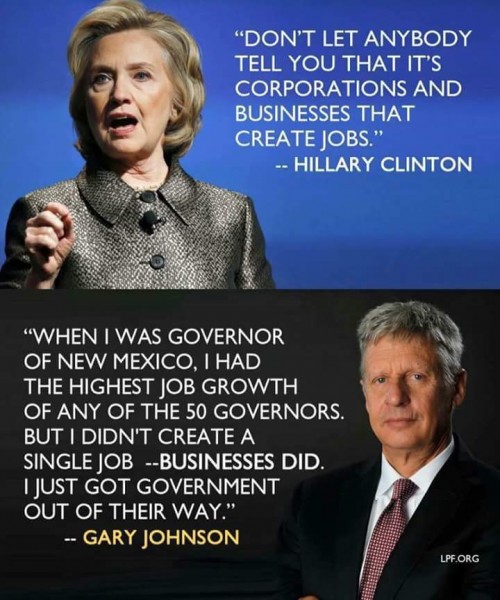
Only government creates jobs in California
If California’s economy is so great, then why is the California economic news all about homeless people and illegal immigrants when we are supposed to be at full employment? Full employment means that everyone has a job and wages are increasing due to a shortage of qualified workers.
We have millions of able bodied people on the dole in our State. California has one third of all welfare cases in the United States, a huge chunk of illegal aliens, and a large portion of the nation’s homeless. Liberals admit that these problems are getting worst not better but on the other-hand, these same folks are claiming we are at full employment. Can you say logical disconnect?
The reality is we have a shortage of housing that normal people can afford. Heck, apparently folks in San Francisco are so miserable that they can’t even afford toilet paper and indoor plumbing.
This is one of the results of socialism. Under socialists and totalitarians, there is an elite group of haves and another of have-nots. The middleclass all but disappears leaving a huge gulf between rich and poor.
The real story here is that California is a mess and that Gavin Newsom may end up having his utopian hands ties by an economic downturn caused by Sacramento’s draconian tax policies.
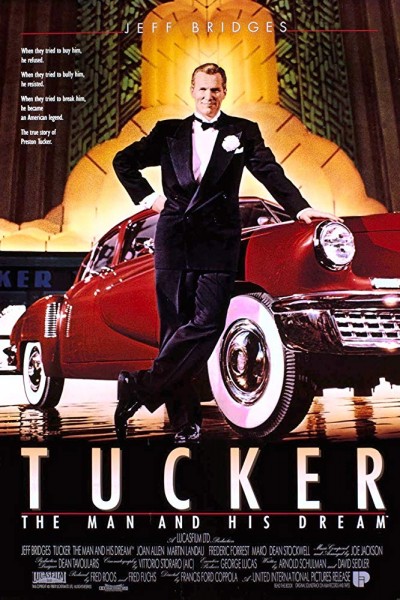
Elon Musk and his fantasy car company Tesla were in the news with a strange story. It reminded me of the movie Tucker when the 1950’s car company was taken to court for ripping off investors for selling dealerships with no cars. In the days leading up to the trial, Tucker and his band of merry men, cobble together 50 cars to show that he had production capability and his business model wasn’t a scam. Tucker rolled the 50 cars onto the grounds of the courthouse and lost his company anyway. These 50 cars are still in existence today and are among the most desirable collectables.
Tucker: The Man and His Dream
Tesla Background
Tesla is burning through its cash at an unsustainable rate. Their credit and stock have been downgraded. Then media reports surfaced a week ago that orders for the Tesla car for the everyday person (Model for $35K) were being cancelled faster that new orders were coming in. Tesla has never hit their promised production goal of ten thousand cars per week.
Early this morning, analysts at the New York-based investment banker downgraded Tesla shares from hold to underperform (Wall Street-speak for “sell”). Needham cited several reasons for its newly bearish stance on the electric-car maker, as outlined in a report on StreetInsider.com
Complicating matters further, Needham notes that its “checks” on the market show that Tesla is experiencing net cancellations of Model 3 orders by customers as “refunds are outpacing deposits.” The analyst believes this trend is accelerating, with as many as 24% of would-be buyers now asking for their money back.
In a coup de grace, Needham ends with a point on Tesla’s cash burn.
Tesla burned through $4.1 billion in negative free cash flow last year—twice its $2 billion reported loss and more than twice the $1.6 billion in negative free cash flow it suffered in 2016, according to data from S&P Global Market Intelligence. Faster Model 3 production is supposed to mitigate cash burn, but Needham believes Tesla will still go through a further $6 billion “through 2020.”
The analyst also notes that Tesla has a $1.5 billion debt payment coming due in 2019. Although Tesla has enough cash in the bank ($2.7 billion, according to S&P Global figures) to cover that payment now, continued cash burn will eat away at it, meaning that by the time Tesla’s debt comes due, it may not have cash on hand to pay it. That implies additional debt issuance (i.e., paying debt with more debt) or stock sales (i.e., dilution) may be necessary to keep Tesla solvent.
None of this adds up to much of a buy thesis for Tesla stock—but it may justify a sell.
In addition to the above, Elon Musk has been saying stupid stuff on Twitter; especially about the divers that saved the cave kids.
At a crucial juncture for the company, which is struggling to show it can mass-produce an electric sedan and generate cash, Musk has tangled very publicly with government regulators, stock analysts, journalists, former employees — even the creator of a farting-unicorn coffee mug.
On Sunday morning, after a rescue diver took to CNN to criticize as a “PR stunt” Musk’s offer of a small submarine to transport a Thai soccer team out of a flooded labyrinthine cave, Musk called the man a “pedo” on Twitter — short for pedophile.
Musk soon removed the tweet but not until the unsubstantiated slur had ricocheted around the world. The diver told reporters he’s thinking about suing Musk.
Tesla has yet to officially comment on Musk’s accusation. Thus far, Tesla’s board of directors has been silent on the matter. But on Monday, Tesla’s stock fell 2.75%, to $310.10. It is down 14% since Musk announced on July 2 that Tesla had hit a goal of producing 5,000 Model 3s a week.
Musk’s confrontations come as he continues to struggle to fix crippling production problems with the Model 3 electric sedan, which Musk regards as a “bet the company” proposition.
The production goal Tesla hit earlier this month lags far behind earlier benchmarks set by the company. In August 2017, Musk told stock analysts there should be “zero concern” the company would hit 10,000 Model 3s a week by the end of this year. The calendar says that’s still possible, but he’s currently struggling to sustain the 5,000-a-week rate.
Meanwhile, the company’s cash pile continues to shrink. When a section of the Model 3 assembly line was shut down after Musk — who is not only the company’s chief executive but also its chief engineer — failed at an aggressive attempt at robot automation, he set up a tent in a parking lot at the company’s Fremont, Calif., factory to handle the overflow, with partly finished car bodies transported from factory to tent on tractor beds and forklifts.
Tesla Yesterday
Portions of the Internet blew-up yesterday when it was announced that some enterprising fellow on Twitter had found a whole lot full of thousands of Tesla cars. Shortly thereafter, another bunch was found in another city.
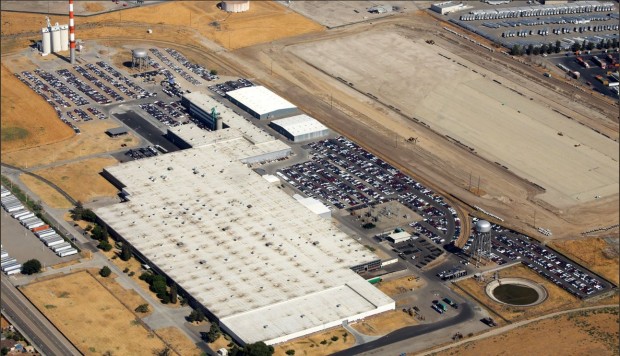
Aerials of the facility identified earlier today at 500 E Louise Ave, Lathrop, CA…more to come, but I didn’t want to make people wait any longer to see the big picture.
Yesterday, several Twitter sleuths uncovered two parking lots, in Lathrop, California, and the other in Burbank, California, at which several thousand Tesla Model 3s are being stored.
The thousands of Model 3 cars are jammed together on dusty lots, baking in the California sun. Approximately 2,500 in Lathrop and another 2,000 in Burbank.
And what ever could be the reason for Tesla storing hundreds of millions of dollars of inventory in dusty lots when it instead could be converting the cars to cash, given what it claims is strong demand?
Is it logistical chaos? Do the cars need rework? Is it all part of some grand plan?
I don’t have the answers, but the questions are not going away.
Tesla’s (TSLA) grand plan was to avoid hitting the magic 200,000 federal income tax credit limit in Q2. To that end, Tesla would stockpile cars near the end of Q2 so it could unleash them in Q3, as every car it delivers in the U.S. in Q3 and Q4 will qualify for the full credit.
Tesla evidently executed the first part of the plan, stopping just short of the 200,000 number as June ended, reporting more than 11,000 Model 3 cars in transit.
So, is this just a tax dodge? A Tucker moment to boost faith in the company or what? Remember that Musk has been cutting employees in some parts of his empire and working others like dogs. Tesla has been promising production numbers of ten thousand units a week for the last several years but has failed to deliver. They also absorbed the debt from Solar City. And as shown above, he is in bad shape.
As I was researching for this blog, I found an opinion piece that expresses what I was about to say so I will just quote it. This was published earlier today.
One disastrous tweet has finally revealed Elon Musk for what he is: a fraud.
Enraged that a British cave diver called his idea to rescue the Thai soccer team for what it was — “a p.r. stunt [with] absolutely no chance of working” — Musk took to Twitter and called him a “pedo.”
Just like that, Tesla’s market value plummeted by $2 billion.
Musk has been in business since 2002. His stated goal is nothing short of transforming humanity through his products: his electric cars, space travel, and an underground high-speed Hyperloop system.
He has yet to succeed at anything but somehow spins every failure into proof of imminent success. His only accomplishment has been this decades-long Jedi mind trick.
Tesla is best known for blowing deadlines and consistently falling short on production.
In November 2017, Bloomberg reported that the company burns through $500,000 per hour. For two years now, Tesla has been suffering an epic talent drain and in May, two top execs — one the liaison with the National Transportation Safety Board — walked out the door.
Tesla was founded in 2003, but the world’s largest automakers quickly surpassed Musk’s vision for electric vehicles. Tesla will never catch up. Shareholders are finally catching on.
So should the government, which reportedly gifts Musk’s companies with an estimated $4.9 billion in subsidies.
Star investor Jim Chanos called Tesla a “walking insolvency” back in 2016. He doubled down in December, saying Tesla is “headed for a brick wall.”
What Next?
Musk is playing games with the Tesla company and that is nothing new. He is a cross between P.T. Barnum, Preston Tucker, and the fictional character played by Danny DeVito in “Other People’s Money”. Musk is using other people’s money to bring a utopian energy dream of environmentalists and Leftists of many stripes to fruition. The reality is that Musk is ultimately going to live or die in the free market. Every time the Establishment types bet on winners and losers, we all lose. Musk is a dreamer and an idea guy. What he sells is smoke and mirrors, the realities of making a profitable product on such a large scale are beyond him but as long as he can keep people investing in the pyramid then it keeps going.
The fact that there is no infrastructure to keep the electric car business running is something people are willfully neglecting. You don’t have the freedom to drive Tesla cars anywhere you want. Even in states like New York and California, most of the state has no ability to charge electric vehicles. Also, where is all the electric generation to keep such a fleet of battery operated vehicles going to come from? Especially when most folks will want to charge their cars at night. These same states are outlawing every known electric generation method in existence with the hope that solar and wind will be the answer. But that’s my point, there is no existing reliable form of energy production except technology based on nuclear or hydrocarbon fuels. Liberal energy policy is based on bad science and wishful thinking.
The self-driving technology employed by Tesla is a class action lawsuit ready to happen. Sooner or later the government is going to be forced to confront Musk for the safety record of his vehicles. Currently, government is trying to shelter him from the consequences of the deaths caused by failures of his system. How many deaths does it take to call the Tesla product defective? Other automakers and insurance folks are watching this aspect of the Tesla company. This might be the path to the financial ruin of one Elon Musk.
Elon Musk’s dress rehearsal for leaving his troubles behind
That Musk appears to be playing games with Washington to keep the Federal tax credit in place is disturbing. Again, at some point the government giveaways will end and he will have to stand on his own two feet. Some day soon, the free market will decide Musk’s fate. Donald Trump winning the 2016 election was his worst financial nightmare. Had Hillary Clinton won, the floodgates of government incentives would have flowed to Musk for decades. California’s mandate that all houses built after 2020 must have solar will benefit Musk but it’s not enough to bail-out the Solar City albatross that he wrapped around the necks of Tesla investors.
Musk is running out of time, money, and excuses. Lucky for him, Mars is a nonextradition planet. At least he might utilize SpaceX for a unique exit strategy for his financial problems.
Sportscaster, Howard Cosell, famously told it like it was. People either loved him or hated him, but Howard was never shy about expressing his point of view. He grew-up in New York and folks couldn’t deny his love of sports. To many of us, Howard was a big part of what made Monday Night Football a phenomenon for many decades. Howard also helped to make Muhammed Ali and Evil Knievel the household names that they were in the 1970’s.
ABC’s Howard Cosell
In the same frank, plain talking sort of way, President Donald Trump just completed a very successful trip to Europe that has folks here up in arms about nothing.
Below are what I think are the four accomplishments of this trip.
England
Trump took grief for allegedly insulting the Prime Minister for telling her to honor the vote of her own people and get out of the European Union; i.e. Brexit. The British leadership is feckless and frozen with fear. Trump wanted them to be decisive and act.
Germany
Trump told Germany that it was stupid to get all their country’s energy needs from Russia. If NATO was created to protect Europe from Russia then why enrich Russia with this monopolistic energy deal? It is a conflict of interest to be in NATO and have this deal with Russia at the same time.
NATO
Trump told NATO nations that they need to take an active interest in defending their countries. Most NATO countries contribute nothing and let the United States pick-up the tab for military spending that they should be paying. This was a campaign promise of Trump so why does the media and many of these nations act like this is something new? The media always bitches about the U.S. being the world’s policeman and then complains when Trump asks them to stand on their own two feet so we don’t have too. If a Democrat said this they would be cheering.
Putin
Trump met with Putin. No on mike whispering that after the next election the President would be in a better position to do favors for them like we had with Obama. The media is stuck on stupid about Russian and the election. If the Russians did anything, it was to make Hillary look bad—which only takes a mirror—but this idea that Trump and Russia collaborated to thwart the Democrats and steal the election is just sour grapes. Yes, many of us really do hate Hillary and think the only reason that she had a political career was because she slept with Bill. She has no ideas or accomplishments; she was an incompetent Secretary of State and her track record was painted red with the blood of people all over the world that died because she was/is an idiot.
President departing Air Force One
Trump had a good trip to Europe. How can you tell? Because the media and the political class are having kittens. They talk and Trump does. That ladies and gentlemen is the difference. They still can’t believe that Trump believed all that stuff he promised in the campaign and is trying to make it happen. Donald Trump, promises made, promises kept. That is how you Make America Great Again.
Campbell’s Soup is probably the second worst run organization in the country right now, CRA being #1. However, Campbell’s situation is fixable, not so much for the CRA.
Some background first, Campbell’s Soup Company owns many brands including; the namesake soup line, Pepperidge Farm, Prego, Pace, V8, and Goldfish among others. The problem is that these brands are all “center of the store” items that have been experiencing little to no growth over the last decade. Consumer tastes have been changing. People are not reaching for canned soup much anymore since the economy has improved and we are not in a recession. The fact that a can of soup might cost you $3 doesn’t help either. For not much more, I can get the Hungry Man dinner and be full after eating it.
As a result, Campbell’s CEO Denise Morrison, who is by far the most incompetent person leading any organization now except maybe ESPN, went on a buying spree to try to save face and earn goodwill with shareholders.
Denise Morrison, shopping ‘til her company stock dropped
In a little over a decade Campbell bought; Plum Organics (2013), Bolthouse Farms a carrot growing company (2012), Kelsen Group baked goods (2013), Garden Fresh Gourmet salsa line (2015), and many other lesser known companies. Here is the issue with all these acquisitions, Plum Organics is an organic line of baby food and salad dressing, and there is much competition in this space. Bolthouse is a yogurt and Salad dressing line, again major competition, but also they own a carrot farm for producing baby carrots, my question here is why? You’re a canned goods company not a carrot growing company! Kelsen baked goods isn’t going to move the needle much sales wise and they are far more popular overseas than in the US. Garden Fresh also made very little sense, you already own Pace salsa line, now you are adding a little known organic salsa line? Again why?
Maybe Morrison should start by getting the carrots out of her ears. These acquisitions show a Board of Directors and Executive out of step with changing trends in a shrinking industry. However, this wasn’t the last acquisition this desperate company pulled off. In a quest to ensure their bonuses and stock options vest, Denise Morrison pulled off the most idiotic acquisition in a long while buying Snyder’s-Lance for 6.1 billion (2017). Synder’s is the maker of pretzels, potato chips, Emerald Nuts, and Pop Secret popcorn. I call this a horrible acquisition because none of those brands except maybe Emerald are desirable. As far as potato chips go; Kettle Brand, Cape Cod and Jay’s are ok, but Frito Lay owns the whole aisle! Pop Secret? I’m not sure how large the market is for popcorn, but I cannot see this being the answer to all that ails Campbell. Basically, Campbell panicked and overpaid for a very average company whose brands are at best number 2 or 3 in their respective categories. Basically what I am saying here is why grab a bag of Cape Cod when you can buy Ruffles or Tostitos? The acquisition was completed, and the results were um… yeah.. just as most expected.
The company booked a $393 million-dollar loss one quarter after closing on the Synder’s-Lance deal, and that wasn’t even the most disastrous thing that happened that day. CEO Denise Morrison unexpectedly “retired.” Give their earning, this was expected. These CEO types who are used to living a privileged life hate when things don’t go their way and as a result take the easy way out. These thin-skinned types do not care much for adversity (much like Congressional Republican leadership). Golden Parachutes have their privileges as long as they’re used before the stuff really hits the fan.
Morrison was vicious as far as layoffs go, closing 2 plants during her tenure, one of which being in Blog Father’s backyard, Sacramento. Morrison knew she couldn’t do anything more for the company short of euthanizing it and took the weasel way out; thus, leaving the chair of the board and her CFO Anthony DeSilvestro to take the heat on the quarterly conference call. DiSilvestro I’m convinced is Dilbert from the comic strip in human form…not talking about the smartest person here. Not to be undone, Morrison nominated herself for sainthood on the way out, saying her acquisitions are paving the way for a bright future at the company…of course what was she supposed to say? By the way, the new interim CEO has essentially put the company up for sale and they are looking for either a buyer for parts of the company or the whole thing.
Campbell’s CFO Anthony DeSilvestro
Here is the bottom line and the biggest issue, Campbell’s made a fatal mistake going on a buying spree trying to make their company something it was not. Legacy Campbell’s is a preservative loaded canned soup, salsa, and sauces business. This type of business throws-off lots of free cash to be reinvested into the business, pay down debt, or be returned to shareholders. There is nothing wrong with this type of business. Tastes may change over time but if you’re feeling ill, Campbell’s chicken noodle soup would usually do the trick. However, instead of sticking with what they know, Campbell’s tried to become a trendy, fresh, farm to fork type company and failed badly. They are a canned and packaged goods company. They tried to grow carrots, but this division has lost millions over the past 3 years. The fresh salsa, salad dressings etc. have had the same fate. Now the company finds itself in a pickle after yet another ill-fated acquisition.
Here is my solution.
Keep the soup business. This is your namesake and legacy product. Sell the carrot farm and the fresh salsa and salad dressing business, this is not your core. Keep Pace and Prego as they are also your legacy and very well known. Dump Pepperidge Farms and most of the Synder’s-Lance business. Sadly, this is never going to pan out, way too much competition in that space.
This is where the problem lies with my solution, no one really wants those spare parts. The only answer is to call a company like Kraft-Heinz and see if they will buy you outright.
Could the struggling Campbell Soup Co. have a suitor?
The Kraft Heinz Co. (NASDAQ: KHC) is reportedly interested in buying Campbell Soup Co. (NYSE: CPB), according to the New York Post, citing sources familiar with the matter.
Sadly, a debt laden dinosaur with no vision won’t attract many buyers. Inept management does this to a great company. I have a feeling the company won’t exist independently much longer. Campbell’s too big to fail strategy and move to get hip and trendy has utterly imploded. As a show of good faith to shareholders, fire that Dilbert look alike. Oh, and lastly, if things get really bad and there’s anything worth salvaging, look for Uncle Pennybags to show-up at the fire sale to liquidate the carcass.
First some history. CALPERS (California Public Employees Retirement System) is for civil service (Union) employees at state, county and local levels; excluding teachers as they have a separate pension provider. California also has one of the most generous pension formulas in the entire country, even with the recent changes enacted by Supreme Ayatollah Jerry Brown. (Note that the State’s pension reforms are not retroactive but only affect new hires.)
In California we have a defined benefit plan, meaning we use a calculation that comes up with an amount of money that the retiree will get monthly for the rest of their life.
Defined Contribution
In the “real world”, you might have four percent of your wages set aside in a 401K or other pension plan. Then your employer will kick in an additional amount, say two percent. Whatever you manage to squirrel away in your working years is yours to live off of in retirement. This is called defined contribution.
Defined Benefit
The amount taken from a state employee’s check has nothing to do with the amount they get in retirement. As long as a state retiree draws breath, he draws a pension.
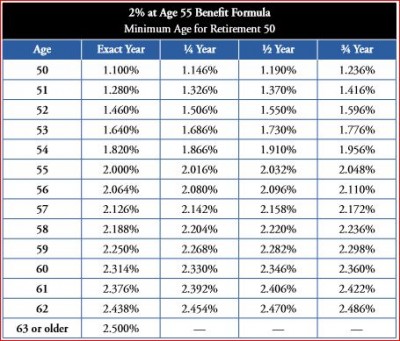
Example. You start at 25 years old and work until 55 years old. 30 (years of service) times 2% equals 60%. You get 60% of your highest year base salary as your pension. If your highest base was 100K you now get 60K to do nothing. They usually have a cost of living increase every year as well.
Here is an actual table from CalPers showing how it works: URL: CalPERS Tier 1
If you have completed 20 years of state service then government also pays your medical insurance.
FYI: State workers can also collect Social Security but in most cases teachers cannot.
Thus if you make $6K monthly, have worked for 20 years, and retire at age 55, you get $2,400 for the rest of you days. If you live to 90, that’s $1,008,000 plus medical and Social Security!
It is not uncommon for many civil servants to retire at between ages 50-55 because “they make more money retired than still working” because retirement checks can be more than net pay while working. Couple that with life expectancy which until recently is getting longer and longer and it’s no wonder that some workers are collecting pension checks for longer than their number of years worked. The system was not designed to work this way. Worse yet, the generation currently entering retirement years—the generation age 50 and up—are doing everything in their power to destroy future generations long after they die. I will outline this below.
Games People Play
Gaming the overtime system, is a big part of the pension issue. This abuse is most prevalent with prison guards and public safety workers. Between having a colleague call-in sick or not being at work because they are enjoying the generous vacation policy while feeding at the government trough, those that wish, have abundant opportunities to work overtime shifts. Some more egregious examples in recent media reports include a BART janitor sleeping in a closet while claiming he works 20 hour shifts and CalFire firefighters that claim to work several days straight when in reality they were drinking and partying it up while on duty! No one seems to miss a chance to game the system.
Oh by the way, when a union renegotiates its contract with the state, or any other municipality, it frequently includes retroactive pay and bonuses for its members.
Other cases include: applying for the same job in a more expensive area (think the bay area or coast) to get a major salary boost for the sole purpose of juicing your pension by an extra $400 or so a month! This is known as pension spiking.
My personal favorite, promoting a colleague who intends to retire in a couple years, but due to his accrual of 999 days of sick leave he continues “working” by calling out sick for 3 years. Nice gig if you can get it. This cheating is very widespread, it’s going on everywhere. There are quite a few more stories but it sounds like there is more juicing going on in the public worker sector than in all of Major League Baseball during the 2000’s.
Pension Crisis in a Nutshell
This gets me to the meat and potatoes of this blog. If your city, municipality, county, transportation agency, etc. belongs to CALPERS then they have to pay a set amount of money annually into the pension fund to cover the costs of their retirees. For most of these municipalities, those costs are somewhat manageable right now, accounting for roughly 10% of their annual budgets. Again, I said somewhat because in 2023 it will balloon to 18% of their total budgets with the increases CALPERS is charging them to participate.
This will become an even bigger issue at some point. Right now we are in a period of economic growth—even though wages aren’t growing—but what happens when we have a major recessionary event? One that lasts several years, like during the Bush/Obama years? My main cause for sounding the alarm now is that cities are already claiming to be strapped for funding to do even basic things like road work. Have you seen a government entity’s pay scale? Guess what? It’s nothing like the private sector; every single year you get an increase, with its steps and columns. In addition to great salary, and benefits, when was the last time the government actually laid off any workers? (Hearing crickets) In the private sector as has been detailed here and elsewhere, when your company has a bad quarter, a percentage of the workforce is terminated.
Again, we have current and future pension funding issues and the number of government workers and retirees continues to grow not shrink. Just think about it. When President Obama or Governor Brown talked about creating jobs, it was the government sector that they were growing most.
Is There Hope
Now how to combat this issue? Well honestly there is no attainable answer. The problem is the unions along with local and state politicians control everything about this. As we have chronicled before, government doesn’t even show future pension obligations on their financial statements. They only care about the current fiscal year. This is GAAP accounting for government entities. Want to change the contribution amounts for state workers? Meet the same fate Gov. Arnold did, when his special election propositions went down in flames. (This election is what caused Arnold to reject any pretense of Republican values.) Try to raise the contribution by the worker by just half a percent, the union and the workers will literally scream bloody murder. If you are a Democrat politician and you try to change the rules for retiree pension plans, may God have mercy on your soul (if you are a believer) because you will most certainly be on the receiving end of several million dollars in attack ads aiding your opponent next election.
Since nothing gets done at the elected level, cities and interest groups choose to push through initiatives for sales tax increases. These increases are packaged and pushed as “we need to hire more police” or “The District Attorney won’t prosecute low level crimes without this tax hike.” This is baloney, because the government doesn’t follow through at all. They use a straw man argument to play to your emotions to get you to agree to a tax hike that funds legacy pension costs. My understanding from the Blog Father is Sacramento County tried to do this with Measure B, the sales tax to fix and repair roads, it BARELY failed at the ballot box. CRA didn’t take a stand on this by the way. (Note: CRA contacted me via the Sith Lord and said they took offense at this remark by Mr. X and did vote to oppose Measure M. I know that CRA never submitted a ballot argument against Measure M but I did.—editor)
My point is they play to your emotion by using fear, the phone may not be answered at 911 because there won’t be any police on the streets, or your house will burn down because the firefighters won’t be able to make it to your house in time. Even trying to chip away at these pension benefits comes with a steep price. John Chiang has been one of the most vocal in California about this, and he is barely registering a blip in the polls for governor. The big question is, what happens when these sales tax increases don’t pass?
Last month, the Legislature actually had several chances to take a crack at mending the pension system. The two hero legislators were John Moorloch from southern California, a Republican, and Steve Glazer from the Bay Area, a Democrat who used to work for Brown, put forth 3 different bills. None got a hearing with the state senate committee charged with overseeing public retirement plans. Glazer wanted a switch from the defined benefit plans to 401k plans to attract a younger work force that maybe doesn’t want to be in civil servant for life. Moorloch wanted to slow down cost of living adjustments until CALPERS gets more solvent. Basically saying the next recession could bankrupt it. The chair of that committee said it best, I want more people on defined benefit plans than 401k plans. Take note, the private sector has very, very, few pension plans left.
In reality, taxes, fees, and fines (like traffic tickets) will be raised and be more plentiful due to cities needing to collect more revenue to balance budgets. This is why your red light (Cooper Cam) violation cost $600. It’s not because they want you to feel financial pain but they need to balance the budget. Sales taxes can help somewhat, but tickets help the most. We will see if Prop 13 survives this CALPERS assault on city budgets as well, I bet it won’t—especially after November.
Don’t forget that should California finally go bankrupt, the Legislature has put the union pensions first in line. As it stands now, by law, retirees will be paid in full before anyone currently working for government gets a dime of state money. I wish someone would take this pension issue to court before we get to the breaking point, as it will likely take 2 federal judges and the Supreme Court to rule this unconstitutional. But in the meantime the public pension racket in California is the union’s golden goose and is untouchable.
Hi, how is the local economy doing near you? I recently toured some areas in California with the Blog Father and was stunned at what I saw. I saw shopping malls and strip malls opening all over the Sacramento area; however, these are all low paying, barely minimum wage jobs, few of which offer any benefits!
I am old enough to remember when Ronald Reagan, whose modern-day heir is alleged by all you CRA and Tea Party folks to be Theodore Cruz, felt if the economy isn’t adding close 500k jobs a month we were going backwards, not growing! I find it ironic that the US population is 35 percent more than 1980 and adding half that number of jobs is regarded as a thriving economy. No wonder so many college graduates are living with their parents while they pay off their crushing student loan debt.
In the Reagan era, most jobs were decent paying private sector jobs; think factories, office buildings, etc. Now the jobs we are “gaining” are low skilled, low paying jobs, and oh by the way, the job numbers now also include a growing number government jobs, so I guess low wage and government sectors are growing nicely in this “service economy”; at least that is what I saw in sunny California. In the Blog Father’s town, several new government buildings have been added and several more are scheduled to be built. I guess if you owned the local Five Guys, BJ’s, Subway, etc. you are doing better but I argue the economy in general is doing poor and we are living in a mirage economy.
Look at how most corporations such as Intel, Apple, or even Comcast organization their employees. For example, I had Comcast install cable at my house; however, I noticed something funny when the technician showed up. The truck and their identification badges read: O. C. C. Communications, no Comcast logo anywhere. When I questioned this, not wanting to let strangers into my house, they said they were independent contractors used by Comcast for installs and service work. Since they were the only guys knocking on my door during the time the appointment was scheduled I let them in.
These guys do not work for Comcast; instead, they are contracted out and paid by the job, no benefits, or anything. Intel does the same thing, I bet in the Ivory Tower in Folsom, most of those “employees” are not affiliated with Intel at all, just vendors or contractors. The guy who delivered my FedEx package? He works for Package Delivery LLC, not FedEx. Want to take odds he is a contractor as well?
Now there are benefits to having a mostly contracted workforce do not get me wrong. Corporate labor costs become just another fixed expense because the details are somebody else’s problem. This makes product prices lower and outsources compliance to government’s myriad of labor regulations.
Such a workforce could/should be more motivated. Labor suppliers are motivated to perform because they know that their contract could end and they all may be terminated after a set date based on performance. Such an arrangement gives the parent company limited liability exposure if the labor force does poor workmanship.
But now the downside. In such an arrangement, you have no bargaining power, and no rights. If your “contracted employer” wants you gone…adios. You get no healthcare and pay no taxes so you’re on your own to settle up with Uncle Sam at Tax time. You are 100% at the mercy of your contracted company. If the contract goes out for bid and your company doesn’t bid the lowest, you’re out of a job. You are essentially a Labor Ready employee, knowing full well you are 100% disposable and completely at the mercy of your employer.
In our economy, there exists a tier below even this level. This is the “gig economy”.
In a gig economy, temporary, flexible jobs are commonplace and companies tend toward hiring independent contractors and freelancers instead of full-time employees. A gig economy undermines the traditional economy of full-time workers…
Examples of the gig economy are companies like Airbnb, Uber and Lyft. Again you are an independent contractor but you are able to work in your spare time, as much or as little as you want.
Here is the problem with this system….government regulation. Well that fear is coming true in California, as the State Supreme Court ruled those workers need to be classified as employees not contractors. Yes folks that Uber ride you take to the airport, used to be $15, likely will be $25 soon.
This is the way it works folks, if you’re no longer a contracted worker then your employer is not going to allow you to wait around in your house for your Uber app to ding saying someone requested a ride. So you will be burning more gasoline driving around aimlessly. Oh what’s that, you want to work the late shift? Sorry we need you to work the morning shift! What’s that you don’t like it? You’re fired. Really the end game here is the State of California wants to allow these folks to unionize and pay more dues into the system to elect more socialists to give them “handouts.” This ruling actually hurts the people who depend on it the most, I’m talking in terms of Uber, Lyft etc. The gig economy allows younger people to work whenever they feel like it and earn a little extra money on the side, like to buy and smoke weed for example, or pay off your student loans, or something.
The gig economy has its place. It’s a nice supplemental income to support your minimum wage paycheck. Also it can be fun to have flexible hours. Lost in all this is the idea that the minimum wage was intended as a training and entry level wage, not something to continue earning for the rest of your adult life. It is not the minimum income to support a family and be a productive member of society.
This court ruling is being aimed at cracking down on big businesses trying to skate employment law, but it’s going to hurt the ones who depend on it most. I learned a lot about how millennial and Gen-X live these past few days. As much as I faulted them for being “live in your parent’s basement types”, boy was I wrong. How does one live on a paycheck of $1,750 gross a month? Especially when an apartment costs $1,100, and you have a car payment, insurance, cell phone, cable bill etc.? Along with $100k in student loan debt? Yeah I would drive for Lyft or Uber too. It’s too bad because the futures of these kids just got set back a decade, or forced them to become government slaves for life.
However if I may address the other side of this coin, the older workers on contract for a big company. This is a horrible way to live life, no benefits, being lied to, and living on a 90-day contract cycle. Some workers exist in a sort of limbo because the company they went to work for doesn’t want to pay medical or other benefits. Even worse, if the company doesn’t meet earnings expectations for its shareholders, your job could well be outsourced. This was the case for Conagra Brands (Chef Boyardee, Reddi-Whip, and Hunts) as they outsourced their entire sales team (over 1,000 jobs) to a Florida outsourcing company. The bottom line is, in today’s regulatory and Wall Street driven world economy, there are two sides to the coin. Heads I win, Tails you lose.
This is one of the funniest business stories that you will ever read. Now funny can be defined as humorous or occasionally as peculiar. This story has elements of both. Had this happened to some little backwater company it might even be viewed as tragic but when the company is one of the biggest multinational technology companies in the world then it’s funny.
This story happened in South Korea a few weeks ago. Samsung—the guys that make a galaxy of electronic devices including a certain line of smartphones—also happens to own a brokerage company. An employee at Samsung Securities was trying to key in a dividend payment of 1,000 won (the local currency used in South Korea) to a group of 2,018 employees. Now 1,000 won is about 94 cents in US dollars. Instead of keying-in this amount for a dividend payment for each share the employees owned, some Samsung employee issued 1,000 shares of Samsung stock for each share owned by the employee group.
Samsung—home of the biggest math error in the Galaxy
The dividend was supposed to be 1,000 won ($0.94) per share. But the employee mistook the form of measurement, confusing won and shares. The error caused Samsung Securities to issue a dividend that was 1,000 times the value of each share held by the group of employees.
In all, the company deposited 2.8 billion shares worth more than 111.8 trillion won ($104.8 billion) into employee accounts—more than 30 times the company’s existing issued shares.
A Samsung Securities spokeswoman said the firm realized the mistake shortly after, but failed to take immediate action.
Sixteen staff members sold a collective five million shares worth about $186.9 million minutes shortly after receiving them. It took the brokerage 37 minutes to completely block employees from selling the accidental shares, according to South Korea’s Financial Supervisory Services, a financial watchdog.
Some of the 16 staffers sold stock despite receiving warnings from the company not to do so, the FSS said. Samsung Securities said employees who had done so—along with the employee who had made the initial calculation mistake—have been temporarily suspended from their duties.
Unless you are a CRA member, living under a rock, voted for Hillary, or have any Park Family Genes in your DNA, you have likely heard Toys R Us is liquidating their business here in the United States and all over the globe. What caused a giant big box that controlled 20% of the toy market to collapse you may ask? Well a combination of things, but the internet, Amazon.com and high prices were none of them.
First some background on Toys R Us. The company was founded in 1948 by Charles Lazarus who interestingly died the same day the company decided to liquidate all stores. The company had sustained success and was even referred to as a “category killer” which is similar to how people view Amazon.com today (a company that is almost impossible to compete with).
Editor’s note: As a child, the highlight of every Christmas was receiving the Sear’s Christmas catalog. In my youth this was Christmas. We only wanted to get toys from Sears because it was literally a one-stop shop for everything. From their catalog, our parents could order anything and have it waiting for us under the tree. Seemingly out on nowhere, along came Toys R Us and stole Christmas from the oldest and most well-known retailer in the country.
Retail icon, Toys R Us, fades into oblivion
The company prospered for many decades but in the late 1990’s Toys R Us started having issues competing with Target, Wal-Mart, and Amazon.com. In 1998 it fell behind Wal-Mart in market share. This is when the chain’s issues started. They tried Kids R Us, a clothing discount chain, and it failed badly and was liquidated after 5 short years. They began growing their Babies R Us chain, to essentially focus on commodities like diapers and bottles, this was also a bad decision. Even more costly was the expensive remodeling of all stores in 2000 by former FAO Schwartz CEO John Eyler. This predictably didn’t change the competitive landscape so in 2005 with the stock struggling on Wall Street, it was sold in a leveraged buyout to 3 private equity firms. This further exasperated the problems facing Toys R Us. The buyout to take Toys private was 6.6 billion dollars, led by Bain Capital (After Mitt Romney had left) Vornado Realty Trust, and Kohlberg Kravis & Roberts.
Leveraged buyouts are not always bad things, there are benefits to being private and you do not have to answer to public investors on Wall Street and can work out corporate and company issues behind closed doors. In N Out and Chick-fil-A are both private and the lines are out the door, down the street, and in most cases backed up to the freeway! Michael Dell—yes that Dell—took the company he founded, Dell Computer, private. Dell Computer had been struggling for many years but taking it private has allowed it to turn around. Typically, after these types of buyouts, private equity firms wind up taking the company public again (more on this later).
So how do these buyouts work? When a public company has a major drop in stock price and has fundamental issues like Toys did, then in come the White Knights saying they can fix everything and will offer to buy the shares of the entire company. In the case of Toys, the private equity guys offered a price 67% higher than what the shares were trading for on Wall Street; banks are happy, stockholders are typically happy, everyone gets paid and then the company is private. In the case of Toys, it was 6.6 billion. So, did the private equity guys have to pay 6.6 billion for Toys? No, they borrowed the money from investment banks—think Goldman Sachs, Morgan Stanley, etc.—and used the company’s cash flow as collateral. Truth be told, the private equity guys in this case likely put up only about 10% of that 6.6 billion.
So, from the start, Toys had a debt load of 6 billion to pay back, at interest rates likely in the 8-9% range! Banks extract large fees from these loans and add it to the debt load—think the housing crisis circa 2008. The banks just rolled the expenses into the loan then sold it to an unsuspecting group of investors. In this case Toys was now controlled by 3 large companies that didn’t know how to run the toy business at all. However, one thing these 3 companies know a lot about is how to extract money from their investment, (more on this later as well).
So after the dust settled, Toys was saddled with 400 million in annual interest payments to satisfy the terms of their loan. Think about that, 400 million in annual revenue goes first to paying off debt interest, not keeping the lights on or paying salary, just debt. Then the private equity companies charge a “management fee” of usually 2-3% of revenue every year, further straining cash flow to pay bills. Then they pay themselves a dividend every year of around 5-8% on their “investment” once again straining cash flow even further.
With sales falling, Toys began to run low on cash. As a result, cuts had to happen across the company because no way would the private equity companies take a cut in fees. In such circumstances, the research and development department gets cuts first, then other sales, general and administrative expenses are slashed next, followed by a hiring freeze, then changes to the accounts payable department. What used to be 30 or 45 day terms are changed to 60 or 90 day terms. After that benefits are cut/eliminated and salaries for new hires are slashed to minimum wage. This is all being done to pay interest and dividends to private equity companies.
The result of this ultimately led to the death of the company. Because of financial constraints, Toys can’t innovate much. For example, toys are only made by a couple different companies—Hasbro and Mattel being the big ones—so in a sense you are limited by their innovation in that space. On price, Toys only had about 800 stores in the United States compared to Wal-Mart and Target which have 800 in the western U.S. alone. This hurt the negotiation power Toys had with suppliers. For example, Toys wants to buy one million GI Joe toys from Hasbro, and Hasbro sells them to Toys for $10 a unit. Wal-Mart orders three million GI Joe toys and Hasbro cuts them a volume discount based on $7 a unit. As a result Toys sold GI Joe for $14 and Wal-Mart could sell for $10. Toys then agreed to price match the competition, so now on that same GI Joe instead of making $4 per unit, they were breaking even; such a business model is not sustainable.
Also, there was no money being re-invested back into the business. Toys used to be known as a huge demonstration and interactive place for children to visit, try out the toys, and then scream and cry until mom or dad bought it for them. Those demo areas disappeared. Toys became a big box store and worse yet couldn’t compete on price with other big box stores like Wal-Mart. In a world where price is now everything, Toys had an advantage at one time. The child could play with and decide they want the product and unfortunately for the parents, they couldn’t wait two days for Amazon Prime because little Mike wanted it NOW.
Even as the business declined, Toys still controlled 20% of the market. Finally, the private equity guys turned to turnaround artist David Brandon, you may recognize the name, he turned Domino’s Pizza into the company it is today and brought it back from the dead. The problem for Toys was that it was too late. Toys remodeled several hundred stores, brought back the demo areas, improved their website, but the damage from private equity had been done. The flow of money away from operations led to customers opting for other big box stores or internet websites. They couldn’t attract top talent anymore and began to close stores several tranches at a time.
This spooked suppliers and as a result; Hasbro, LEGO, and Mattel changed the terms under which they would sell products to Toys. The result, Toys ran out of inventory during the Christmas shopping season! With unsustainable debt, the company could not pay its bills and as a result the only option left was bankruptcy protection. A big store like Toys—similar to Sports Authority and Sport Chalet—no way the creditors would allow them to go through a restructure, they would need to liquidate. Thus, the end of Toys R Us. But don’t feel bad for the private equity groups. They collected fees and dividends for over 15 years and then during bankruptcy sold the inventory and everything else to liquidation firms. Additionally the lack of profitability also gives tax advantages to these groups since they tend to own many companies. The employees? They got nothing, except a pink slip of course.
Could Toys have been saved…I think so; there is room for a toy store chain in the United States. This is what I would have done. I would have run the stores similarly to Best Buy or a grocery store. I would have found a tenant or two to sublease floor space, so they could demo their own products. I would have set up an area to host children’s birthday parties, and maybe reached out to LEGO to see if they wanted to create a LEGO Land in the stores. This would give predictable cash flow every month and given you a way to spruce up your business to make it more appealing to customers. Have you been to a Best Buy lately? I don’t even think Best Buy owns much of its own leased stores; Pacific Sales, Sprint, T-Mobile, Magnolia, Google, and HP/Apple lease a ton of floor space from them. As far as price match goes, that’s a battle big box stores win by attrition. I would have focused on making the stores into a place both parent and child want to go to because I don’t think anyone admits publicly to wanting to go to Wal-Mart. But alas, a large part of most people’s childhood is gone with the wind.
“X”
Last week, I took a roadtrip to Ogden Utah to see the middle child. Along the way I had a few ideas that might end up being blog topics but I thought I’d jot down some thoughts that I had.
First, Elon Musk is a fraud. As soon as you depart the once Golden State in your privately owned vehicle, you will find zero charging stations along the Interstate 80 corridor. While electric vehicle travel within California is a sketchy proposition, outside of California it is not possible or practical. Hybrid automobiles are a rare sight away from the Left Coast and electric ones are unheard-of.
Musk thinks he can sell ten thousand vehicles a week and sustain that production? It’s a Ponzi scheme. He can’t even get to 5K per week and is running out of cash and good will.
Musk is a flimflam guy of the first order and gets lots of other people’s money (often tax dollars) from Liberals to do stuff that is not market based because these guys believe that governments not markets should decide what our economy should look like. The AB-32 crowd wants to use the power of the State to force us into electric vehicles that are not able to leave the gilded cage of California just because it is their religion. Their arrogance to pick losers and winners is hubris of the highest order.
Second, the path from Reno to Salt Lake City is the only proof of a universal flood anybody should need. Except for a few mountains here and there, this whole path is clearly a shallow sea that was only recently drained. This was within the last few millennia not millions of years ago.
Third, Brigham Young sure picked a crappy spot to proclaim the new Zion. My biggest gripe of the area is the lack of trees. But he did have big plans.
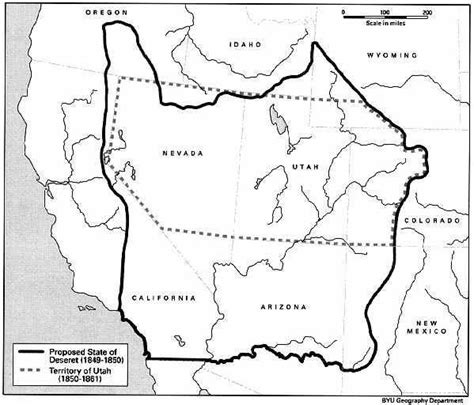
The Territory of Deseret would have comprised roughly all the lands between the Sierra Nevada and the Rockies, and between the border with Mexico northward to include parts of the Oregon Territory, as well as the coast of California south of the Santa Monica Mountains (including the existing settlements of Los Angeles and San Diego). This included the entire watershed of the Colorado River (excluding the lands south of the border with Mexico), as well as the entire area of the Great Basin. The proposal encompassed nearly all of present-day Utah and Nevada, large portions of California and Arizona, and parts of Colorado, New Mexico, Wyoming, Idaho, and Oregon.
Brigham seems to have wanted the 1840’s version of “fly-over country” to be united under his banner; whether as a state or a separate country depends on what you read. The presence of Los Angeles and San Diego as part of his territory would indicate a separate nation was in the back of his mind. The war of northern aggression ended that dream and he reluctantly settled for Utah statehood after yet another rewrite of Mormon Scriptures to get rid of polygamy. Why the “god’ of Mormons is not the same yesterday, today, and forever like the one revealed in the Bible is a subject for another day.
Fourth, the amount of indigent and homeless people in Ogden really surprised me. Latter Day Saints try really hard to cultivate the reputation that they care for their own—maybe they do—but for the folks outside their church, clearly they are on their own.
Fifth, the amount of young people with ridiculous amounts of body art and piercing was a surprise to me. I was expecting Donny and Marie type youth but clearly not everyone follows this expectation. My wife thinks that Ogden draws youth from outside the LDS world for the skiing. Maybe this is true. Clearly a large segment of young people are nonconformist.
Sixth was a news story that I saw on the local television station. This is interesting because the LDS church is front and center of a story about a man named Joseph Bishop.
(Note: Although the LDS church has clergy with the title of “bishop” this is not the same as in Protestant Christian Churches and not Mr. Bishop’s title just his last name.)
Mr. Bishop was in charge of training youth that knock on your door as missionaries. Mr. Bishop is accused of giving private lessons to some of the female candidates under his care—much like President Clinton did in the Oval Office with Monica.
SALT LAKE CITY — (KUTV) – On March 20, as a sexual assault scandal was exploding around former Missionary Training Center President Joseph Bishop, his son, and attorney Greg Bishop sent an email to 2News unsolicited.
In the email, he unspools a five-page dossier about the past of the woman who had accused his father of rape.
The email included the woman’s criminal record, alleged false allegations she’d made in the past, and jobs she’d lost.
It even included details about an incident that occurred when she was 17 years old. Bishop encouraged reporters to examine the woman’s past adding, “consider the source.”
In the last two days, 2News has obtained a letter that was written by David Jordan, a lawyer at the firm, Stoel Rives,acting on behalf of The Church of Jesus Christ of Latter-day Saints.
The document is a response to a letter from the woman’s attorney, Craig Vernon, requesting a settlement from the LDS Church.
The document includes everything we saw in Bishop’s email, plus a review of her ecclesiastical church record.
At the bottom, the Jordan indicates that he sent the letter to Greg Bishop.
It appears Bishop took portions of the letter, and at times, repeated allegations word for word and sent it to the media.
The woman told 2News Bishop had been grooming her, taking her out of class to talk about the sexual abuse she had suffered as a child. She said he seemed to enjoy the discussion, then one day he invited her to a place he called, “special.”
“He didn’t tell me there was a bed or a TV or a VCR down there, he just said it was this really special room,” she said.
“I was nervous and uncomfortable, and I should have listened to that feeling.”
Once she and Bishop got into the small room, he advanced on her.
“He tried to kiss me and I pushed him off, I was like, ‘oh my gosh, here’s this old man, I’m 21 years old,” she said. “Then he pulled my blouse and rips my buttons off. It had little pearl buttons, then he ripped the back of my skirt, it was an A-line skirt, and then with one hand he pulled my garment and my pantyhose down, there he was, trying to rape me.”
The woman tried to tell officials in the LDS Church on multiple occasions including her bishop.
2News documented as many as four times when the woman tried to speak out to church leaders, but the woman says she had told as many as 10 different church leaders about the alleged abuse.
“Oh no, oh no, I have been talking to bishops and stake presidents for years; one bishop in Colorado Springs called me a liar and wouldn’t even talk to me.”
I find it interesting that the LDS Church saw fit to release a letter concerning the character of the accuser and defending Mr. Bishop by saying there is no need for them to look into this matter. The LDS church has a long history of circling the wagons when things don’t go their way.
Here is another example of the “see something, say something” mentality. Put yourself in her place, do you want your church releasing an official letter about your past?
When has your church ever made an issue of your:
• Juvenile behavior?
• Morals?
• Employment record?
• Criminal record?
• Marital status?
Sorry, I thought churches were in the business of changing lives thru the power of God’s Word not keeping a tally of what notorious sinners we are just in case they need to shut us up.
At the same time this story is going on, another one about sexual abuse had faithful Mormons marching in the streets.
Seventh, we went to Easter services at an Orthodox Presbyterian Church in Ogden. It was a nice service that emphasized the importance of the bodily resurrection of Christ.