Author: William

  • Travel Update November 9th

    Travel Update November 9th

    This post discusses illness and medical practice in the Philippines. I have three health things that I’ve been juggling on this trip, food borne illness, a lousy cold, and some wonderful tropical “crud” that has attacked my skin.

    Today I finally got the “all clear” from the doctor; no pneumonia. My cold is getting better but way past three weeks of suffering. The good news is that most of my labs are ok as well. My A1C was 5.5 or average blood sugar of 111. The red and white cell counts were just below the normal band but the other labs that I’ve had are good.

    The one lingering issue is antibiotics for some kind of skin infection that I picked up. When I told the doctor about it, she wrote me two prescriptions without even looking for herself. The medication she gave me is helping but I may need a proper follow-up later in the week.

    So far, medical care has been cheaper than the United States. My doctor visits have all required cash payments, but the costs are nominal. Trying to round-up the drugs prescribed by the doctor has been more of a challenge. One antibiotic required trips to about 5 pharmacies before we started finding partial fulfillments of the prescription. Pharmacy #4 had four of ten pills and pharmacy #5 had another six pills.

    As for illness from food, the Erceflora tends to be the best help. Sometimes I just have to say “no” to eating. My girl is letting me eat enough “safe” fast food to keep me going. Some street food is just off limits, and I have to trust the more expensive places to employ minimal standards of food safety. For the most part this has been working. To say eating here is a “crap shoot” is literally a thing which I wish to avoid.

    People think I’m nuts for coming here for two months but knowing that you will have down time from food borne illness is just a given here.

    It is essential to find a cheap place to stay with a good bathroom setup. A clean room to suffer in is a must. Folks, when in the tropics, you will have to share your room with critters. The only issue is which ones. Three-inch-long cockroaches, ants, termites, mosquitoes, gnats, flies, and lizards are a few of the things that I’ve encountered at various places. Then there are blackouts and water outages. Bathing and flushing are privileges, not rights here. As mentioned earlier, toilet paper is a scarce item that some places just don’t have or provide.

    The hotel that I have been staying in is a mixed bag. The water in our room kept going out and we were repeatedly told it was a planned outage. Sometimes that was untrue. One room that we were in—note that we have stayed in three different rooms and switched rooms five times—had zero water pressure while the adjoining room was just fine. It turns out that the plumbing in our third room simply didn’t work. Finally, the hotel had some workers come in for a day and then magically the water worked correctly.

    I think the building is settling due to a lack of rain and something got crimped. The hotel swimming pool is directly above the five rooms downstairs. I frankly don’t trust that building standards here are all that good or consistent. I think partial blame goes to local construction techniques.

    The other issue here that makes me uncomfortable sometimes is the smell of human waste that you can encounter just about anywhere. Yep, places here can smell worse than Las Vegas. Imaging going to the farmer’s market or local street bazaar and seeing guys cooking meat on an open fire and the waste line is seeping through the ground next to their booth. Or the fresh flower vendor or fruit stand. It is just a reality here that this happens.

    Local governments here are spending large amounts of money to improve storm water flooding and drainage but somehow much of the money disappears via graft, bribery, or corruption. It seems to be a joke here that the spending will result in a net benefit for local residents. I think it’s true of sewage as well. Lots were spent for a limited public benefit.

    In the last couple of days, both my girlfriend and I have celebrated our birthdays. She is a really kind and generous person. I’m glad she is in my life.

    I plan to write a review of my current hotel before I depart. Also, Attorney Mario news is coming, maybe as soon as tomorrow. I will be leaving in just over two weeks. My current plan is for a frozen TV dinner on Thanksgiving Day. Oh, and some honest-to-goodness ice cream would be nice too.

  • Another Trip Update for October 28th

    Another Trip Update for October 28th

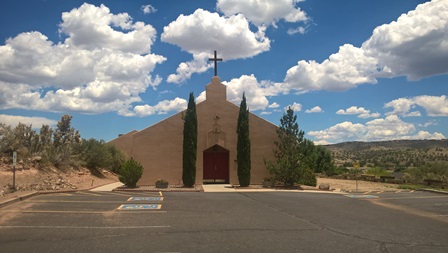
    This week I attended Freegen Church in Lapu Lapu. This is my girl’s old church. This was our second visit this month. I was wearing a prominent colored shirt and made a short video of the praise music which I later posted on Facebook. Yesterday, I found out that the photo collage that went on social media after the Sunday service had a photo of me recording the video amongst their posts.

    William at Freegen Church October 25th–photo from Freegen’s Facebook page

    Folks, Freegen is a large protestant church by Philippine standards. I would guess their attendance is close to 450 people. The other church that we attend is probably about 70 people. Please don’t ask me about denominational affiliations because I can’t find much on such things here.

    My concern with Freegen is that it seems to be into the prosperity gospel. In a country of poor people, I get the emphasis on money and blessings, but wow! At one time, my girl was in leadership in this church. They were expected to give ten percent plus more of their income or God would not bless them. Reportedly, this info was tracked by the church to keep you paid-up, oh, I mean honest. Following the sermon was the offering, it was not a simple passing of the hat but a multi-PowerPoint slide show of verses promising that God wants you to prosper and experience blessings both of health and finances. This begins by giving him your tithe—also called “seed money.”

    Also part of the service was encouraging attendees to spend time with the Holy Spirit who would guide them with personal revelation. Folks, if I was just a bit more charitable, I might dismiss this as a cultural thing, but I can’t. What happened to testing the spirits to see if they are from God? Isn’t that why we have the Bible, to know God’s Word and will for our lives?

    During the last two Sundays at Freegen, I never once heard the word “sin” nor anything about Jesus dying for our sins. The “blood of Jesus” was mentioned once in passing. Sorry, but I’m stuck on how any man can come to Jesus on our terms, without seeking forgiveness and feeling contrite for being a lawbreaker before a holy and righteous God.  

    The text two Sundays ago was John Chapter 3 verses 1 to 31. When is the last time you heard a sermon that spoke about John 3:16 and didn’t talk about Jesus dying for sinful man? I was stunned. Yet sin and our need for a Savior was omitted. We may have differences about what it means that “Jesus is the Savior of the world” but it is a biblical fact. When a man in the pulpit passes over a chance to share the Gospel, I have to question whether he is giving the full counsel of God.

    Lastly, the first time that I went this month, all the songs were in English and the second time most were in the local dialect. I’m sure the music wasn’t Hillsong because nothing had a musical “bridge” in the middle of it.

    The following day, I spent my day in bed. I have a lousy cold, I caught it from my girl, but she has been a good nurse. We did get out for a little while yesterday. I wanted bland food and some iced tea, so we made the trek to Tom and Tom’s coffee shop. I bought her a nice lunch and ate two pretzels and enjoyed two cups of English breakfast tea.

    Lately we have watched a few movies in the evening. Some I brought on my laptop and a few on Amazon. Please note that offerings on Amazon are different here than in the US. One of our first movies was Up.

    Once she got into it, it was fun. I have many memories of the movie; many tied to our time at Redeemer Presbyterian Church in Elk Grove. I thought about Jesse Winton’s Sunday School class on the movie, watching it with Sheryl and James, Jesse’s renunciation of his faith and James walking a similar path of rebellion, and of course my marriage to Sheryl and her death. Up is, in part, a movie that encourages the old man to start a life after his tragic loss; something I can relate too also. 

    My girl also liked the movie Red so I rented Red 2 the following night so she could see that too. She is ok with action movies as long as the good guy gets the girl; so am I by the way.

    Folks, I’m gonna get honest and slightly graphic on this next subject. Please don’t read the next couple of paragraphs during or immediately after a meal.

    The offensive subject is toilets.

    Yep, being in a strange country and eating food with questionable handling is a risky proposition. I never will claim to have a cast iron stomach. In the Philippines, many toilets don’t have seats, and no I don’t mean the paper liners that you put on the seat, I mean the actual seat. Also, optional is toilet paper. Recently, I had to use the recently installed toilet in my girl’s apartment.

    Folks, the standard bathroom in the Philippines is a “wet room.” The shower, toilet, and sink are in the same place with no division. If the engineering is right, everything drains to the shower. (Yes, Virginia, the toilet does flush but if you wash it off, the excess goes down the shower drain.) Next to most toilets is a flexible chrome hose with a spray nozzle. Nope, it’s not for people experiencing “that time of the month” but for use when there is no toilet paper. Using such a toilet configuration requires preplanning—at least if you want to depart said facility with dry clothing.

    Before sitting, you must remove all clothing below the waste and find a place to hang it. Then do your business. Next, using the spray nozzle and your hand of choice, clean your backside. Hopefully, some soap is handy to help. Once your backside is clean, wash your hands and then get dressed. Bonus thought: some public toilets don’t have doors for privacy either.

    Yep, in a city of 200,000 plus people and zero pine needles, sometimes it’s the best you can hope for.

    On to the next subject.

    Lastly, we played the part of rich tourists. I actually did this twice in the last week.

    The first time was this story.

    At Mactan Newtown, home of the Gordon Ramsey’s restaurants, we kept getting flyers encouraging us to purchase a condo in the area. After initially declining, we decided to check it out.

    We looked at a two-bedroom condo on the 7th floor of a building. It actually had a third space that could be used as a laundry room and or baby room. I think it was supposed to be for the maid, but whatever. Folks the space was about the same size as the barn that I live in—my house is 840 SF. The things that came with it were several swimming pools, weight room, a private beach with full-time staff, a few bars, parking and other amenities.

    Oh, the beach area has parking, if you want a designated parking space at the condo, that’s an extra 2 million pesos or about $32,000 for the privilege.

    The cost of the condo proper was 20 million pesos or about $330,000. The HOA fees were on a square footage basis (actually per square meter, but you get the idea) and came out to about $160 per month. The condo had three different ways to get you into the place at some outrageous monthly payments that all stopped at the 3-year point and then required a balloon payment of 70 percent—the remaining balance or third-party financing. We were told the builder would finance you at 12 percent or try a local bank for a rate near 8 percent on the balance.  

    Besides the fact that I don’t have an idle $300,000 sitting in the bank, my questions about long term outlook for the place kind of nagged at my conscience. The builder wanted the first 30 percent rather rapidly and then cast folks adrift to figure out how to finance the rest. This begged the question of what happens when all the spaces have been sold and the builder moves on to other projects. Do the maintenance and facilities still get serviced or do the fees—be they called HOA or whatever—truly cover the costs or is that a loss leader to get you on the hook for a huge increase later.

    The places that we were shown had plumbing for electric instant water heaters—which was an extra charge—and some low-tech stoves. Folks, for $300,000 I really want some type of glass convection cook top and a decent oven. No demo housing had microwave ovens, garbage disposals, or dish washers. Please understand that many places with these on demand water heaters do not have both hot and cold running water. You set a temperature at the water heater and that’s what you get for the shower; period. There is no way at the shower valve to set a mix of hot and cold water to give you the temperature that you desire. In the case of married folks, one person is comfortable and the other gets frozen or scalded; sorry but there is no middle ground. I have to question if the shower is pure hot water or is able to mix hot and cold sources. I base that on my experience in the hotel where I am staying now as well as the fact that the laundry area in the condo had only one water hook-up valve. Oh, said laundry area had no ability to vent the dryer outdoors either.

    The other issue we encountered was ownership. Per the salespeople, 40 percent of ownership was designated for foreigners. Ownership of the condo was 50 years, but for an extra fee, it could be extended another 25 years, for a total of 75 years. However, if a Filippino bought the condo, they could own it forever.

    Somehow, I think the local government has property taxes waiting in the wings for people like me. Do locals and foreigners get the same tax treatment? Somehow, I have reservations about this but since I didn’t buy, I may never know.

    Oh, my other moment as part of the one percent was at the local political rally on Saturday. For a few minutes, I was asked to pass myself off as a foreign investor in the local “barangay”—think police precinct or neighborhood. Yep, I was given a place on the platform with all the local honchos but thankfully, nobody shoved a microphone in my face. I just sat there and smiled—ok, maybe like a deer in the headlights but I had the presence of mind to not say anything dumb. It was a ruse to get the local police chief to come out to our car to get his birthday surprise. The old gent turned 61 and his co-workers got him flowers, a cake, and other fixings. Folks he gave a very long-winded speech. I think we had to wait about two hours to spring the surprise on him. (Thankfully, I didn’t get on the stage until he was finished talking.)  

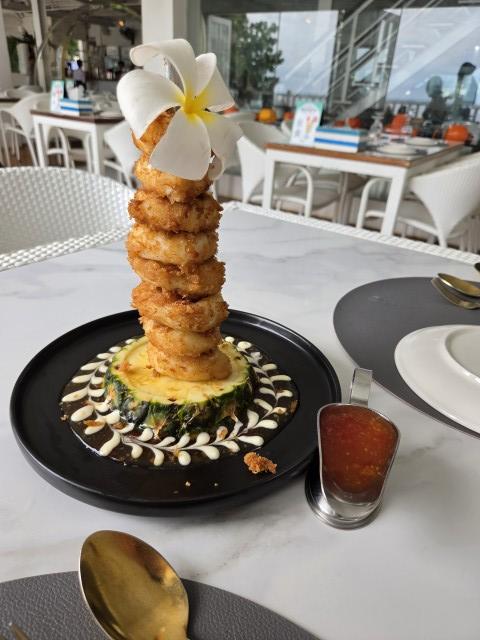
    Calamari rings with onion batter at Cabana

    Anyway, it ended well and happily. We hit the Cabana, the sister restaurant to The Cove, on the way home.

    Cabana Restaurant October 24th

    Anyway, that’s my week so far.

  • Review: Medical Issues Lead to Hospitalization

    Review: Medical Issues Lead to Hospitalization

    Yep. Monday of last week I spent about 5.5 hours in the Emergency Room. Here’s the details.

    Sunday (the previous day), we went to Shakey’s Pizza after church and got lunch. There were a few chicken wings left and a couple slices of pizza. So, many hours later, guess what we had for dinner? Yep. Please understand that said leftovers were sitting in a plastic bag unrefrigerated for the entire time that lapsed from lunch to dinner. I tried to tell her this was a bad idea but …

    By the next day, Montezuma’s Philippine equivalent was having his revenge on me. I was doing the “bottom blow” with much frequency. Over-the-counter remedies were not working. My girl decided to whisk me away to the nearest hospital.

    Folks, it was not going to the hospital that bothered me, it was the relative unavailability of public toilets between here and there that caused me the most concern. As mentioned in a previous blog post, toilets here are difficult to find while on the road and notoriously filthy by American standards if you do happen to find one.

    Anyway, we got to the hospital without incident and then the fun started. My girl had to explain why I was there and what we expected from the crew in the emergency room. After much discussion in the local dialect, I was asked to submit payment of 7,700 pesos (~$128) for lab work. The time stamp on my payment receipt was 6:20 AM.

    I was then placed in a curtained-off area that I was sharing with about 5 other people. I experienced a blood-draw from my left arm, near the elbow. I was then given an IV needle in the top of my right-hand, this was followed by two medications being injected. The first was no big deal but the second one burned while going into my hand. I was given two small disposable plastic cups with lids and sent to a bathroom. The doctors wanted samples of #1 and #2. After the first bathroom trip, I was hooked up to a bottle of saline solution. I was attached to this bottle for the duration of my stay.

    My girl’s oldest sister and husband came to the hospital to check on me. They stayed for at least an hour. It was nice to see them although I didn’t think I was sick enough to justify the visit.

    Having some fluids pumped into you is usually part of the solution to food poisoning as dehydration is the biggest immediate risk. The labs finally came back in good shape. I was cleared of a bacterial infection from some of the data that was retrieved. This eventually led to me being sent to my hotel for further recovery.

    By the next day, I was better but then ate something else that was disagreeable. We implemented the doctor’s discharge orders and a battery of over-the-counter stuff. RC Flora apparently comes in two different solutions or potencies or something like that. She found the stronger stuff at 96 pesos per vial. I chugged some of that and some pills and some other stuff that was mixed with drinking water. A day later, I was better but more cautious.

    That night or the next, five of us decided to eat at a local dive. Having been sick twice within a few days, I was cautious about eating at this place. The other five were picking out mystery meat on a stick to have cooked (think BBQ) and then served. Said meat was in a tidy display case that kept the insects out, but … said meat was not refrigerated. It was just sitting there all day long until some adventurous folks like our party decided to eat said stuff. Once I figured out that nothing was refrigerated, I took a hard pass on ordering anything. It was the right choice.

    After a hospital visit, my girl is much more considerate of my comparatively fussy bowels.

    We did stop Saturday night at a different local place; much of the stuff there was in display cases and iced so I took the risk and agreed to dine there. It was good food. I didn’t suffer any ill effects from the food and enjoyed my meal.

    Folks, I know I will have a few bouts of food poisoning while in this part of the world. It’s just part of the experience. It’s one reason my stay is so long, I know I will be out of commission a couple of times while here. I’m still glad that I came for a visit.

    I have no idea whether my weight is up, down, or the same. I only know that my blood sugar is staying low while breaking many of the practices that I follow at home. Hopefully, I can avoid food poisoning again. At least I know that a medical emergency won’t bankrupt me if it happens again.

  • Review Gordon Ramsey’s Street Burger

    Review Gordon Ramsey’s Street Burger

    I told my girl that I wanted a burger and a beer. I’m not much of a drinker but it just sounded good. We hopped in the car and drove for about 20 minutes to somewhere I’d never been before. We parked next to a McDonald’s—not a good omen—and then went for a walk.

    We got to the end of a strip—this area looked like a typical downtown area in a midsized city—I’m thinking Sacramento without all the homeless and bums on the streets. Anyway, I see a sign that says “burger” on it. We entered the place and it was nice.

    We were seated and I noticed a Hell’s Kitchen reference and then saw the name Gordon Ramsey on the menu. Being that I’m in Asia, my first thought is that this place is a knockoff that hasn’t heard from Gordon’s legal team yet. Finally, I saw enough things to confirm to me that this probably was a legit Gordon Ramsey restaurant.

    I decided to order the Italian Burger, and my girl got the monthly special, the Beef Wellington Burger. The burgers came with French fries, and we placed a drink order for two lemonades and of course a beer.

    My last and only other experience in a Gordon Ramsey place was the pilgrimage that my wife and I made to Las Vegas to visit Ramsey’s Hell’s Kitchen restaurant. We had to go through Vegas to get to our son’s college Freshman parent’s weekend in Arizona. Man, that seems a lifetime ago. Anyway, our tab for a Hell’s Kitchen dinner was about $350. We thought of it as a bucket list sort of outing which it was.

    In contrast our meal at Ramsey’s Street Burger was a whopping $28.

    Italian Burger

    The burgers both tasted good. My girl was nice enough to give me a sample of her Wellington. The French fries were crisp and seemed oil-free. I’d compare them to In-and-Out but without oil. I don’t know Ramsey’s technique; they could be double fried or finished in an air fryer.

    Beef Wellington Burger-includes bacon, mushrooms, sauce

    The Ramsey experience was essentially high-end food truck food.

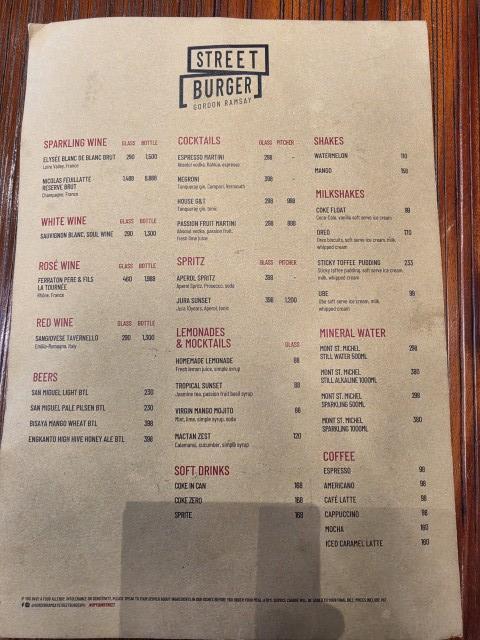
    The menu shown below is in Philippine pesos. To convert to dollars, divide the price by 60.

    Compared to Philippine prices, Ramsey’s prices are outrageous, but then again, this place is located in a high-end tourist area, so his pricing is fair.

    I’d give it a 4.5 or there abouts. And yes, I’d gladly go again.

  • Misc Comments on My Trip Thus Far

    Misc Comments on My Trip Thus Far

    I’m about ten days into this trip. Here are a few observations thus far.

    Getting a visa extension to stay here was easy. The hardest part was the demand that payment be made in cash. The cost was just north of 4,000 pesos ($66). I needed to complete a form, pay a fee, and then get the document processed. Your US passport gets you a 30 day stay. Processing the extension gets you an additional 29 days for total of 59 days. If you wish to stay longer, show up about a week before expiration and apply again. I don’t know what the next fee will be but for now let’s assume another 4K.

    I guess the See’s two-pound box of mixed nuts was a hit. I gave it to my girl’s sister and never saw it again. We are still working on the almonds coated in dark chocolate. I would guess it weighed in at just over a pound. It was hand packed at the See’s outlet in Spokane. By the way, the Spokane location is sketchy and should only be visited during daylight hours.

    The cookies from the Gathering Place in Bonner’s Ferry are just about gone. Those poor things—along with the See’s candy—survived the trip as part of my carry-on luggage.

    Some of the dining places we have visited so far have been great.

    Sunday night, we went to a place with dugout seating areas surrounded by Koi ponds. The place was covered by a metal structure, and we were quite comfortable during the intense thundershower that drenched the area during dinner.

    Pastor and wife, my girl and me

    OK, except for when the Koi decided to splash us at random times. The food was good and it was nice to be joined by pastor and his wife.

    My second Wednesday here, we went to a restaurant near the ferry station that goes to the neighboring island of Bohol. I had visited this area during my last trip here but never went all the way to the end of the pier to notice the restaurant. The seating was covered but outdoors.

    It had a nice view of the water’s edge. It was nicer than the Koi place, except for the fact that they were playing a happy birthday song very loudly and way too often on the sound system.

    We even found two Gordon Ramsey restaurants here. The prices were reasonable and my reviews will be following in later blog posts.

    My girl’s family is having a gathering in our honor in a few days. I bought a bottle of sparkling cider (ok, apple juice) to see if it might be fun to have on hand. I don’t think anybody has tried it before. I plan on introducing it to her in the next few days. The other reason I think nobody here drinks it is because it was on the bottom shelf in the grocery store and there were only two bottles in stock.

    Apple cider update: warm apple cider, that arguably was a Martinelli’s knockoff, just didn’t cut it as a beverage option for the family gathering. This might be a case of refrigeration mattering but it was a nice try.

    Today we opened the laundry that we picked up yesterday. It was washed by a different laundromat than last year. It is located within walking distance of her apartment. The place seemed well maintained and was not busy. The clothing was returned to us clean and neatly folded. Even my delicate clothing—which is what much of my stuff is these days—was in good shape.

    Something else that I’m trying on this trip is using two cell phones. I tried installing an e-sim in my phone on my last trip but the phone only allows one sim at a time to be active. The results were most unsatisfactory. This trip I brought my old cell phone to use as a wi-fi hotspot. I bought a sim card for the old phone and prepaid for data. Now I have a local phone number if I need it and my text messages on my regular (US based phone) work 24/7. The one drawback is that cell phone calls only seem to work while on a hotel wi-fi system. This feature needs more testing to see if I can figure out the limitations of calling via IP.

    After church yesterday we went to Shakey’s Pizza. Nope, not the same as the pizza of my youth. They don’t have honest-to-goodness tomato sauce here and the “cheese” is not really a dairy product—heck most does even require refrigeration here.

    This trip, I haven’t had to drive … yet. Driving here is very different. Most vehicles are motorcycles, many with sidecars that can carry four or five people. There is also a lot of bicycle and pedestrian traffic. Many vehicles driving at night have no or very poor lighting; this also includes trucks. Imagine oncoming traffic with no lights and trying to pass people in narrow streets. To further stir things up, nobody stops at stop signs because they mean something different here, and it’s not stopping. Oh, you come up to a traffic light with no power, in our country we are required to treat such a light as a four-way stop, but not here. Folks here treat a light outage as a regular intersection, if you are thinking survival of the fittest and take your life into your hands, then you are on the right track. I’ve read that driving here is considered the worst place on the planet. I can’t say if that’s true but it might be.

    I’m finishing this post at a place called “Tom N Tom’s Coffee.” My girl has two activities this week related to Attorney Mario and his ongoing work for us. More news about this in a month or so.

    Oh, my staff in Elk Grove and north Idaho are enjoying their reprieve from having to produce content for the blog while I’m away. We are monitoring the upcoming election. Personally, I’m most interested in the Texas Senate race and Idaho’s Prop 1.

    I’m gonna close this post and get started on my review of Gordon Ramsey’s Street Burger. Lot’s of photos incoming on that one.

  • Review: Crown Regency Hotel

    Review: Crown Regency Hotel

    My first hotel experience in Lapu Lapu City was the Crown Regency Hotel. I will be comparing it, in part, with my visit last year. The Crown Regency is an older hotel along a main road in Lapu Lapu City. Per the elevator buttons, it has ten floors. It has a small swimming pool and some cottages as well as the hotel on the property. It costs about $25 a day—give or take.

    Compared to last year, my visit was better. The cockroaches were absent this trip and only tiny ants were visible—mostly in the bathroom area. The hotel has a refrigerator in each room and also a stove for cooking. Please note that said stove is propane, and you need to provide your own tank of explosive gas—oh, I mean propane—as one is not provided for you. As I learned from my previous stay, the Crown Regency has its own generator which was handy last trip as power was out for four days in this half of the province due to a typhoon.

    Lastly, maid service was much improved here. Only in Canada is the maid service more efficient and lethal. During this trip, I was provided with clean towels daily and trash was emptied daily as well. Good job. The hotel seemed to me to be sparsely in use and mostly vacant. At night, the gate to the parking area was closed much of the time to discourage unwanted visitors.

    I have two complaints about my stay this trip, first, when checking in they wanted 2,000 pesos in cash as a deposit. Neither I nor my girl had that amount of cash when I checked in. They finally let me stay without the deposit. Second, I didn’t have any hot water in the shower. The water pressure was good but setting the shower valve to full hot was not noticeably different from full cold. Either choice was roughly room temperature.

    My stay at Crown Regency was about five days. I then moved to a different and slightly cheaper hotel. Said hotel will be the subject of another blog.

    On a scale of five, I would give Crown Regency a rating between 3.5 and 4. There is room for improvement, but it was better than my last trip.

    Closing thoughts. The hotel now has Chinese letters above the entrance that I don’t recall seeing on my last trip. Possibly my memory is bad or they have new management. Also, I did not eat in the restaurant during this trip. The food wasn’t very good on the last trip, but it was literally the only place open for the first two or three days following the typhoon last year. The fact that the employees even showed up following the typhoon last year was a big deal to me. Most folks stayed home to clear debris and care for their families.

  • Review: The Big Taco

    Review: The Big Taco

    I am overseas for the next two months. In honor of the occasion, I will randomly be presenting reviews of stuff that I experienced. My goal is to inform people about what I’m up to without angering my family or others that think they know what’s best for my life.

    First up, is The Big Taco.

    The Big Taco has intrigued me since I learned that our old hangout, Good Burrito, closed a few months after my last visit. Both restaurants are located in Lapu Lapu City, Cebu, Philippines. Finding a Mexican themed restaurant on the Asian side of the Pacific is an interesting proposition. Generally, Mexican food is a safe bet for dining out, but does that hold true here?

    I learned of The Big Taco via a search on the Internet and began to follow their Facebook page many months ago. I vowed to try it when I visit the area next time. The other night we took the long drive to get to that side of the Island.

    The first thing that struck me was the operating hours. My recollection is that they are open from 7 AM to 1 AM. The restaurant is a small storefront. It could probably seat 16 to 18 people. Upon entering, we noticed that there were random shopping bags on one side of the room with a motorcycle helmet prominently protruding from one. There were two female workers in the place that acted as reception and seating. Some of the tables had dirty dishes on them and were in need of bussing. The table locations were random and scattered about. We were the only customers. The seats that we chose were wet. We learned later that was the result of condensation dripping from the roof. Music was playing on a big screen television in the restaurant. It was dance club themed stuff that I had never heard before. It was loud enough to cancel-out the noise of motorcycles driving up and down the busy street.

    We were each brought two menus, one for food and the other for drinks. I picked what I thought was a variety of items on the menu; however, it was pick one of three entrée choices; Taco, Burrito, Quesadilla. Then two sides. Side choice number one was nachos or French fries. Side choice two was salsa or garlic sauce. I picked the burrito entrée and chicken for the meat. For the sides I ordered nachos and choice two was salsa. In addition, I bought one each of chicken, beef, and pork tacos. This was more food than we needed but I wanted a sample of what they had to offer.

    Please note that after we were seated, nobody brought us any chips and salsa. Also, it was never offered to us. Our drinks were brought to the table before the food. I don’t recall ever being asked about any refills. Service was not really anything outstanding. The girls were more interested in watching music videos on YouTube; the same ones we got to watch at a high decibel level on the big screen.

    The food arrived at the same time. The combo plate and then three plates, one for each taco. The combo plate was a burrito wrapped in foil that was neatly cut in half; also on the plate was a small quantity of chips circled around a cup of salsa. We never saw any nachos, only the chips and salsa we should have been served when we were seated.

    Neither the burrito nor any of the tacos had anything resembling Mexica seasoning or spice. The meat was uniformly bland and overwhelmed with a stewed pinto bean concoction that overcame everything else. The taco was presented nicely, and the contents were pleasing to the eye. Also, strangely lacking was any cheese. Sorry kids, but spicy meat, cheese, lettuce, onion, and tomato are the centerpiece of the taco. Cilantro is also a good ingredient on tacos but it too was absent.  The tortilla was a nice sized one and easy to pick up, partially because it was not stuffed with much food.

    We tried the burrito and then some of each of the tacos. My girlfriend, who loved the food at Good Burrito, said several times that she didn’t like the food at The Big Taco and that she never wanted to return. The pinto beans and associated juice simply overwhelmed everything else on the plate. The chips and salsa were good, the pinto beans on the burrito were ok since they didn’t use refried beans in anything we were served; however, it was a deal killer on the tacos.

    Frankly, if they had just copied Del Taco’s food, it would have been better. The Big Taco makes the salsa bars in Elk Grove look like Michelin Star dining.

    Per the Internet, there is a bar and karaoke area, but it is not attached to the dining area. It is a stairwell on the left-hand side of the restaurant entrance.

    I would give The Big Taco two of five stars. Pinto beans are a side dish, especially for tacos, not a main ingredient of a taco.

  • The Times of the Gentiles

    The Times of the Gentiles

    Folks, I just can’t catch a break. I was minding my own business, as best I can at the church Bible study last night and presto, yet another time when we as modern Christians can’t let the Bible define terms but have to project stuff into the text that it plainly never says.

    The study lead brought up the time of the Gentiles. Before speaking, I actually looked up the verse before opening my mouth, not that it helped, but …

    Oh, said passage is Revelation 11:2

    2 But the court which is without the temple leave out, and measure it not; for it is given unto the Gentiles: and the holy city shall they tread under foot forty and two months.

    So, there it is in black and white but as usual, nobody cared. It didn’t agree with Scofield so of course I had to be wrong. A parallel passage is found in Luke 21:24

    24 And they shall fall by the edge of the sword, and shall be led away captive into all nations: and Jerusalem shall be trodden down of the Gentiles, until the times of the Gentiles be fulfilled.

    The leader tried to say that the time of the Gentiles began with the vision of Daniel of the statue representing four kingdoms. And continues until the return of Christ to establish the millennium. Somehow his understanding of the vision always leaves out the fact that the rock (Christ) destroys the statue and that the rock grows into a mountain that fills the whole earth. The rock clearly represents the growth and success of the Gospel which will eventually fill the whole earth.

    Here’s the text from Daniel.

    31 Thou, O king, sawest, and behold a great image. This great image, whose brightness was excellent, stood before thee; and the form thereof was terrible. 32 This image’s head was of fine gold, his breast and his arms of silver, his belly and his thighs of brass, 33 His legs of iron, his feet part of iron and part of clay. 34 Thou sawest till that a stone was cut out fwithout hands, which smote the image upon his feet that were of iron and clay, and brake them to pieces. 35 Then was the iron, the clay, the brass, the silver, and the gold, broken to pieces together, and became like the chaff of the summer threshingfloors; and the wind carried them away, that no place was found for them: and the stone that smote the image became a great mountain, and filled the whole earth.

    Daniel 2:31–35.

    Daniel then interprets the dream.

    36 This is the dream; and we will tell the interpretation thereof before the king. 37 Thou, O king, art a king of kings: for the God of heaven hath given thee a kingdom, power, and strength, and glory. 38 And wheresoever the children of men dwell, the beasts of the field and the fowls of the heaven hath he given into thine hand, and hath made thee ruler over them all. Thou art this head of gold. 39 And after thee shall arise another kingdom inferior to thee, and another third kingdom of brass, which shall bear rule over all the earth. 40 And the fourth kingdom shall be strong as iron: forasmuch as iron breaketh in pieces and subdueth all things: and as iron that breaketh all these, shall it break in pieces and bruise. 41 And whereas thou sawest the feet and toes, part of potters’ clay, and part of iron, the kingdom shall be divided; but there shall be in it of the strength of the iron, forasmuch as thou sawest the iron mixed with miry clay. 42 And as the toes of the feet were part of iron, and part of clay, so the kingdom shall be partly strong, and partly broken. 43 And whereas thou sawest iron mixed with miry clay, they shall mingle themselves with the seed of men: but they shall not cleave one to another, even as iron is not mixed with clay. 44 And in the days of these kings shall the God of heaven set up a kingdom, which shall never be destroyed: and the kingdom shall not be left to other people, but it shall break in pieces and consume all these kingdoms, and it shall stand for ever. 45 Forasmuch as thou sawest that the stone was cut out of the mountain without hands, and that it brake in pieces the iron, the brass, the clay, the silver, and the gold; the great God hath made known to the king what shall come to pass hereafter: and the dream is certain, and the interpretation thereof sure.

    Daniel 2:36–45.

    The four kingdoms are understood as Babylon, Medo-Persia, Greece (Alexander the Great), and Rome. Rome initially protected Christians (see Paul and the book of Acts) but eventually turned on them and became an enemy of God’s people. If you don’t believe me, look up Nero and Roman candles.

    Dispensational Premillennialism Wrong Again

    Below is the Dispensational Premillennial position on the “Time of the Gentiles” per Logos software.

    Jesus speaks of Jerusalem being trampled by Gentiles “until the times of the Gentiles be fulfilled,” (Luke 21:24) a phrase that has generated considerable theological discussion about its scope and endpoint.

    The term refers to God’s use of Gentile nations as instruments of discipline upon Israel1, functioning as a prolonged period of subjugation rather than a brief episode. This era commenced with Israel’s initial oppression in Egypt and will conclude when Christ returns to deliver Israel from Gentile domination and establish their prominence among nations in the millennial kingdom.1

    The chronological boundaries remain debated. One interpretation places the beginning at Nebuchadnezzar’s destruction of Jerusalem and the temple, when Judah was exiled to Babylon, with the conclusion arriving through the Lord’s intervention from heaven.2 Another view suggests the era extends from Jerusalem’s destruction in AD 70 through the end of history.3 Throughout this period, four successive Gentile empires dominate world affairs, as depicted in Daniel’s visions.2

    A common interpretive framework calculates the times of the Gentiles as 2,520 years based on calculations derived from Leviticus 26, yet no specific ending date appears explicitly in Scripture, despite numerous scholarly attempts to identify one.1 The phrase concerns political dominion over the Jewish people rather than the salvation of Gentiles—a distinction important for understanding what “fulfillment” actually entails.1

    1 Finis Jennings Dake, in Dake’s Topics (WORDsearch, 1991). [See here, here, here, here.]

    2 F. W. Grant, Leaves From The Book (Galaxie Software, 2004), 82.

    3 Timothy A. Gabrielson, “Times of the Gentiles,” in The Lexham Bible Dictionary, ed. John D. Barry et al. (Bellingham, WA: Lexham Press, 2016). [See here.]

    Please note that nowhere in the above discussion does anybody cite the actual biblical reference to the times of the Gentiles mentioned in the Bible. Using a term and purposely skipping its definition is clearly sloppy scholarship if not outright dishonesty.

    Oh, in fairness, I did look up the notes for Luke 21:24 and Revelation 11:2 in my Scofield Reference Bible and Scofield claims that the time of the Gentiles began when Babylon captured Jerusalem and destroyed the first temple but as usual he never cites any actual evidence in the Bible to back up his claim.

    Here’s a Contrary View

    The following question was put to me. What follows is my response:

    In Luke 21:24, after the prophecy of the destruction of Jerusalem, it says, “and they will fall by the edge of the sword, and will be led captive into all the nations; and Jerusalem will be trampled underfoot by the Gentiles until the time of the Gentiles be fulfilled.” The man on the street reading this without a theological bias and the person reading this with a literal interpretation would clearly think there is a time gap involved here.

    The “gap” this person is referring to is the time between the destruction of Jerusalem that took place in AD 70 and some yet future time when the Gentiles—the nations—ravage Israel again. Supposedly we are living in that “in-between time” that’s nearly 2000 years long.

    He is assuming a distant future fulfillment when none is implied. It’s certainly in the future for those who heard Jesus’ prophecy around AD 30, but not necessarily in the distant future. The fulfillment of the “times of the Gentiles” occurred when the Gentiles—represented by the Roman armies that made up “the nations” at the time (Rom: 16:25-26; 1 Tim. 3:16; Acts 2:5) and depicted as four kingdoms in Daniel 2–3—acted as God’s agent(1:1–2) in the destruction of the temple and the judgment on the city of Jerusalem.

    Until the Times of the Gentiles are Fulfilled by Gary DeMar 02/09/2021

    DeMar continues:

    Milton Terry wrote the classic work Biblical Hermeneutics, a standard study on biblical interpretation that has been around for more than 135 years. Here’s what he wrote about the time of the Gentiles:

    “The statement of Luke xxi, 24, that “Jerusalem shall be trodden down by the Gentiles until the time of the Gentiles be fulfilled,” is supposed to involve events which did not take place in that generation. The “times of the Gentiles” (kairoi ethnown [nations from the Greek word ethnos from which we get the word “ethnic”]) are assumed to be the times of the opportunities of grace afforded to the Gentiles under the Gospel. But to understand the words in this sense would be, as Van Oosterzee observes, to interpolate a thought entirely foreign to the context. “The times of the Gentiles,” says Bengel, “are the times allotted to the Gentiles to tread down the city;” but there is nothing in the passage or context to authorize his further remark that “these times shall be ended when the Gentiles’ conversion shall be fully consummated,” and that the treading down by Romans, Persians, Saracens, Franks, and Turks is to be understood. These kairoi [times] are manifestly times of judgment upon Jerusalem, not times of salvation to the Gentiles.”

    “The most natural and obvious parallel is Rev. xi. 2, where the outer court of the temple is said to be “given to the Gentiles,” by whom the holy city shall be trodden down forty-two months, a period equivalent to the “time and times and half a time” of Rev. xii, 14, and of Dan. vii, 25; xii, 7. This is a symbolical period of judgment (see above, p. 384 [in Biblical Hermeneutics], but does not denote ages and generations. It is three and a half—a divided seven, a short but signal period of woe. The “times of the Gentiles,” therefore, are the three and a half times (approximating three and a half years) during which the Gentile armies besieged and trampled down Jerusalem. (Milton S. Terry, Biblical Hermeneutics, unabridged ed. (Grand Rapids, MI: Zondervan, n.d.), 445.)”

    Terry is not alone in his interpretation. Heinrich Meyer in his Critical and Exegetical Commentary on Mark-Luke (Trans. Peter Christie (New York: Funk & Wagnalls, 1884), 530–531.) argues in a similar way that “till the times of the Gentiles shall be fulfilled” refer to “the time that the periods which are appointed to the Gentile nations for the completion of divine judgments (not the period of grace for the Gentiles, as Ebrard foists into the passage) shall have run out. Comp. Rev. xi. 2. Such times of the Gentiles are ended in the case in question by the Parousia ([Luke 21:] 25f., 27), which is to occur during the lifetime of the hearers (ver. 28); … hence those καιροί [times]are in no way to be regarded as of longer duration.”

    Closing Comments

    As usual, the Premillennial Dispensationalist position cannot be found in the Bible, only imposed upon it as an interpretive grid. When something agrees, quote it, when it doesn’t, ignore it. When someone cherry-picks texts instead of looking at all the relevant data and then drawing a conclusion, then you know they have their thumb on the scales and are pushing something other than the truth.

    As you can tell, such sloppiness gets me riled up, but I usually manage to keep myself in check. I find that picking my battles in this group is better than insisting on winning the war by bayonetting all the wounded. Instead, I vent on my blog.

  • The Myth of the Antichrist

    The Myth of the Antichrist

    As I touched on in my last installment, the word “antichrist” never appears in the book of Revelation. Yep, it’s a doctrine to many folks but like most of the B.S. propagated by C.I. Scofield, it cannot be found in the actual text of the Bible.

    The Antichrist, of popular culture, is a composite of several different symbols and images that are not related but simply linked together in much the same way as a child would link a few random Legos and then declare it a flower or a spaceship. Abstraction and imagination are more essential to see the Antichrist than sound analysis and fidelity to the biblical text.

    One of the key building blocks for this composite is the Beast of Revelation. Actually, there are two beasts—found in the account in Revelation chapter 13. The sea beast and the land beast. The sea beast is related to the Roman Empire. The sea is a reference to the Gentile nations. The land is a reference to the Jews that live in the “Promised Land”.

    The second thing to point out about the beast is the number given in the latter part of the chapter. Contrary to popular belief, lots of that going around, the number is not six, six, six. It is six hundred, threescore and six. Like all symbols in Revelation, the reference to this number is from the Old Testament.

    Secondly, the text of Revelation 13 states that it was possible for the original hearers and readers of this book to know who the beast was. Yep, like his actual name. That is because Revelation was a prophecy about things about to take place during the lives of the original audience of John’s book. Jesus states that he was coming quickly to the readers of the First Century.

    Six Hundred, Threescore and Six

    Rules for Rulers

    The Old Testament background of this number is rooted in two passages.

    16 But he shall not multiply horses to himself, nor cause the people to return to Egypt, to the end that he should multiply horses: forasmuch as the LORD hath said unto you, Ye shall henceforth return no more that way. 17 Neither shall he multiply wives to himself, that his heart turn not away: neither shall he greatly multiply to himself silver and gold.

    Deuteronomy 17:16–17

    Per my Logos software:

    Deuteronomy 17:16–17 establishes three restrictions on Israel’s king: he must not accumulate horses, multiply wives, or amass silver and gold.

    These prohibitions operate on multiple levels. The restriction on horses prevents the king from building a professional standing army and limits foreign military alliances1, while requiring the monarch to trust Yahweh rather than military strength.2 The prohibition on multiple wives guards against foreign entanglements and the religious compromise that accompanies marriages outside Israel’s covenant community.1 Limiting wealth prevents the king from dominating other Israelites through commercial power and status accumulation.1

    Beyond these specific prohibitions, the rules reflect a broader theological vision. Israel’s king operates under a fundamentally different model than the monarchs of surrounding nations—not conforming to typical ancient Near Eastern expectations of kingship.3 Since Yahweh is Israel’s supreme King, no human monarch may claim absolute power; these limitations force the king to acknowledge his dependence on God.2 The king’s restricted role reflects Deuteronomy’s core theology that Israel functions as a covenant community and brotherhood.3

    1 Patricia Dutcher-Walls, “The Circumscription of the King: Deuteronomy 17: 16–17 in Its Ancient Social Context,” Journal of Biblical Literature (2002), 121:604.

    2 Paul R. Gilchrist, “Deuteronomy,” in Evangelical Commentary on the Bible, Baker Reference Library (Grand Rapids, MI: Baker Book House, 1995), 3:121.

    3 Andreas J. Köstenberger and Gregory Goswell, Biblical Theology: A Canonical, Thematic, and Ethical Approach (Wheaton, IL: Crossway, 2023), 141–143.

    Oh, please note these rules for kings were written by Moses before anyone ever conquered the Promised Land and hundreds of years before Saul was anointed the first king.

    Rulers Breaking the Rules

    Now that you know what the rules were, it’s time to introduce the guy that broke them all. As is often the case, it didn’t take long for Solomon, Israel’s third king, to violate them all in spades.

    Rule 1 Broken: Multiply Horses

    26 And Solomon gathered together chariots and horsemen: and he had a thousand and four hundred chariots, and twelve thousand horsemen, whom he bestowed in the cities for chariots, and with the king at Jerusalem.

    1 Kings 10:26.

    28 And Solomon had horses brought out of Egypt, and linen yarn: the king’s merchants received the linen yarn at a price. 29 And a chariot came up and went out of Egypt for six hundred shekels of silver, and an horse for an hundred and fifty: and so for all the kings of the Hittites, and for the kings of Syria, did they bring them out by their means.

    1 Kings 10:28–29.

    Rule 2 Broken: Multiply Wives

    1 But king Solomon loved many strange women, together with the daughter of Pharaoh, women of the Moabites, Ammonites, Edomites, Zidonians, and Hittites; 2 Of the nations concerning which the LORD said unto the children of Israel, Ye shall not go in to them, neither shall they come in unto you: for surely they will turn away your heart after their gods: Solomon clave unto these in love. 3 And he had seven hundred wives, princesses, and three hundred concubines: and his wives turned away his heart.

    1 Kings 11:1–3.

    Rule 3 Broken: Multiply Silver and Gold

    27 And the king made silver to be in Jerusalem as stones,

    1 Ki 10:27a.

    14 Now the weight of gold that came to Solomon in one year was six hundred threescore and six talents of gold,

    1 Kings 10:14.

    A ruler that breaks the God’s rules is a wicked and rebellious leader. All of what I just explained, and more is packed into the idea that the number of the guy in Revelation 13 is six hundred threescore and six.

    So, who was six hundred threescore and six?

    It was Nero Ceasar. The number of his name written in Hebrew was 666. The textual variant of this verse in Revelation is 616. This is Nero Ceasar written in Greek. Thus, when John wrote:

    Let him that hath understanding count the number of the beast: for it is the number of a man; and his number is Six hundred threescore and six.

    Revelation 13:18.

    He expected that folks reading or hearing Revelation in his day would be capable of solving the riddle.

    The Man of Sin

    Another New Testament character often shoehorned into being part of the composite antichrist is called “the man of sin”.

    This passage is long but here goes:

     3 Let no man deceive you by any means: for that day shall not come, except there come a falling away first, and that man of sin be revealed, the son of perdition; 4 Who opposeth and exalteth himself above all that is called God, or that is worshipped; so that he as God sitteth in the temple of God, shewing himself that he is God. 5 Remember ye not, that, when I was yet with you, I told you these things? 6 And now ye know what withholdeth that he might be revealed in his time. 7 For the mystery of iniquity doth already work: only he who now letteth will let, until he be taken out of the way. 8 And then shall that Wicked be revealed, whom the Lord shall consume with the spirit of his mouth, and shall destroy with the brightness of his coming: 9 Even him, whose coming is after the working of Satan with all power and signs and lying wonders, 10 And with all deceivableness of unrighteousness in them that perish; because they received not the love of the truth, that they might be saved. 11 And for this cause God shall send them strong delusion, that they should believe a lie: 12 That they all might be damned who believed not the truth, but had pleasure in unrighteousness.

    2 Thessalonians 2:2–12.

    No, I am not going to go line-by-line through this passage. The words everyone keys on in this passage are as follows from verse 3: “that man of sin be revealed, the son of perdition.”

    Verse 4 says this guy sits in the temple “shewing himself that he is God”.

    Verses 6 and 7 speak of him being held back until it’s time to be revealed.

    From verse 6, “ye know what withholdeth that he might be revealed in his time.”

    Verse 7 states that whatever was holding this man of sin back will eventually be removed; “only he who now letteth will let, until he be taken out of the way”.

    Here is the same passage from a different translation. It is easier to follow than the King James Version quoted above.

    6 And you know what is restraining him now so that he may be revealed in his time. 7 For the mystery of lawlessness is already at work. Only he who now restrains it will do so until he is out of the way. 8 And then the lawless one will be revealed, whom the Lord Jesus will kill with the breath of his mouth and bring to nothing by the appearance of his coming.

    ESV  2 Thessalonians 2:6–8.

    Folks, there are two main reasons that this passage gets used when making a composite of the antichrist. First, nobody can agree who this guy is or the name of the guy who is restraining him. This makes the passage more malleable. Secondly, and as usual, this time indicators must be ignored to use these verses as part of the composite.

    Folks, who was the original audience?

    If the guy being discussed was alive and contemporary with the Apostle Paul, then he is dead and has been for at least 19 centuries.  Given this important but frequently discarded fact, the only coming where he could have been destroyed was when Jesus came in judgment in AD 70.

    Lastly, this man of sin, whoever he may have been, was a religious leader and not a political figure. The person is clearly and predominantly associated with worship in the Temple, and thus, was alive and active prior to its destruction.

    Daniel 9

    The last place where folks look to mine nuggets to be used in their composite construct, commonly known as “Antichrist,” is in the book of Daniel. None of what is claimed as the modern understanding of antichrist is actually in the text; instead, it is injected there in the form of presuppositions which are added to the text prior to anyone actually reading said texts.

    Daniel chapter 9 begins with this:

    2 In the first year of his reign I Daniel understood by books the number of the years, whereof the word of the LORD came to Jeremiah the prophet, that he would accomplish seventy years in the desolations of Jerusalem.

    Daniel 9:2.

    Daniel takes Jeremiah literally when Jeremiah predicted that the Babylonian captivity would be a period of 70 years. This point will be important later in this discussion. Daniel’s response was repenting of his personal sins and also for the sins committed by his nation; something that I would argue we need to do more of in our day and age.

    As Daniel is praying, the angel Gabriel appears (verse 21). This is important for at least two reasons, first, angels are rarely ever mentioned by name in the Bible and Gabriel is the same angel that announces the pregnancy of the Virgin Mary in the Gospel accounts.

    Gabriel says, “O Daniel, I am now come forth to give thee skill and understanding.” Daniel 9:22.

    Gabriel then tells Daniel of a vision. This is the famous seventy weeks of seven years. Yep, seven times seventy; which, not so coincidentally also shows up in the words of Jesus when he is asked how often one should forgive his brother (Matthew 18:21-22).

    Here is the prophecy given to Daniel:

    24 Seventy weeks are determined upon thy people and upon thy holy city, to finish the transgression, and to make an end of sins, and to make reconciliation for iniquity, and to bring in everlasting righteousness, and to seal up the vision and prophecy, and to anoint the most Holy. 25 Know therefore and understand, that from the going forth of the commandment to restore and to build Jerusalem unto the Messiah the Prince shall be seven weeks, and threescore and two weeks: the street shall be built again, and the wall, even in troublous times. 26 And after threescore and two weeks shall Messiah be cut off, but not for himself: and the people of the prince that shall come shall destroy the city and the sanctuary; and the end thereof shall be with a flood, and unto the end of the war desolations are determined. 27 And he shall confirm the covenant with many for one week: and in the midst of the week he shall cause the sacrifice and the oblation to cease, and for the overspreading of abominations he shall make it desolate, even until the consummation, and that determined shall be poured upon the desolate.

    Daniel 9:24–27.

    Please note that Daniel is told that from when the seventy years of captivity is ended and the reconstruction of Jerusalem begins to the time Messiah is cutoff is seven weeks plus threescore and two weeks. Doing the math, you get 69 (7+60+2) weeks of seven years or 483 (69*7) years. This math is why Simeon and Anna, in the Gospel of Luke (2:22-38) were looking for Messiah before their deaths. Their faith was in the word given to Daniel in this passage.

    After Messiah is cutoff in verse 26, a prince will come and destroy the city and sanctuary. Said war will result in a flood that brings desolation. This vaguely echos Jesus in Matthew 24 invoking the flood of Noah (Matthew 24:38-42) and speaking of abomination that brings desolation (Matthew 24:15).

    Please note that in Daniel 9:27 that this invader will “cause the sacrifice and the oblation to cease…”

    When Roman legions attacked Jerusalem and destroyed the temple, in a war that lasted 42 months or 3 and one half years, the city was destroyed, the temple was razed to the ground as Jesus predicted in Matthew 24:2b “There shall not be left here one stone upon another, that shall not be thrown down.” This destruction was accomplished within one generation of Jesus making the prediction. Furthermore, the Jewish Historian Josephus says that Roman soldiers plowed the dirt upon which the temple had once sat after it was completely destroyed.

    As John records in Revelation, Rome turned on the Jews and destroyed Jerusalem. This was the prediction of Daniel 9 being fulfilled.

    There is no time when the 490 years of the prophecy was stopped or paused. It was completed just as Gabriel told Daniel. No such delay is indicated by the text or context. Yet modern prophecy pimps claim that there is a hidden 2,000 plus year gap being introduced as a parentheses, pause, or unforeseen delay found somewhere in this passage between the 69th and 70th week. They also claim it contains the Rapture doctrine and the C.I. Scofield/Hal Lindsey version of the Antichrist somewhere in all this; plus, a rebuilt 3rd or 4th temple in Jerusalem.

    Again, none of this is found in the text of Scripture, it must be added via an external template or interpretive grid that is read into the text.

    Closing Thoughts

    As I am fond of quoting, “A text without a context is a pretext; usually, for error” Walter Martin.

    If you look at the Scriptures from the point of view of the original hearers and respect the context, then none of the things that you are reading have application for the future. They were all concerned with God’s people living in those times not ours. To claim otherwise, is to make them irrelevant for the last 2,000 plus years.

    However, all Scripture is given for our instruction. We are expected to learn from our history and apply the lessons to our age. This means that history is relevant for us to learn from, not that we are the focus of imminent and unfulfilled prophecy. It’s not about us; it’s about Him and His faithfulness. Because God demonstrated His faithfulness in the past, we know that He will be faithful to us in the present and guide us in the future.

    Scripture was not written to us but for us.

    The idea of antichrist being a ruler of a one-world government and murdering billions of people in a futile attempt to defy God is science fiction. Yes, this type of sensationalism sells millions of books to gullible Christians with itching ears, but it has no sound biblical warrant.

    The biblical warrant is that this world belongs to Jesus Christ and He is ruling now and He will make, and is making, all his enemies his footstool. Our job is to make every area of life subject to His lordship and rule. The kingdom of God is now, and the Kingdom of God is Christian Civilization.

    Burying your God given talents and waiting for the fictional Rapture instead of using them, has resulted in shallow Christianity and paralysis of the faithful. Satan has gained only what God’s people have willingly ceded to him through unbelief, which sadly is quite a lot.

  • Futurism: Seven Years and Other Thoughts

    Futurism: Seven Years and Other Thoughts

    Folks, the short version is this: the phrase “seven years” is never mentioned in the New Testament. Not ever. Never once. But somehow, it’s a doctrine in the minds of most modern evangelicals. Ditto for lots of other proclaimed doctrines. Amongst these are:

    A rebuilt temple in Jerusalem—never mentioned in the New Testament. Jesus said the existing temple would be torn down during the generation that heard his voice. “And Jesus said unto them, See ye not all these things? verily I say unto you, There shall not be left here one stone upon another, that shall not be thrown down.”  Matthew 24:2.

    A pig sacrificed in the temple—never mentioned in the New Testament. Folks, if you take a look at the book of Hebrews, I would argue that every animal sacrifice done in the temple after the Resurrection of Jesus was an abomination—a denial of His once and for all sacrifice. In the years following the Resurrection, the temple itself became an idol for the Jews. Whatever the correct understanding of the abomination of desolation was in the prophecy, it occurred between the Resurrection and the destruction of the temple in 70 A.D. there is no gap of 2,000 plus years between the 69th and seventieth week of Daniel. This is injected into the text by Scofield, not derived from Scripture.

    The Rapture—never mentioned in the New Testament. Appealing to the days of Noah, Jesus says that one is taken and on left, but who was taken in the days of Noah? Sorry kids, the bad guys, not the righteous. The good guys remained on the earth, the wicked perished. This is true throughout the Bible, the wicked are taken in judgment and the righteous remain. The “meek inherit the world”, not heaven.

    A worldwide tribulation—never mentioned in the New Testament. The great tribulation was a local judgement that could be escaped on foot. “Then let them which be in Judaea flee into the mountains.” Matthew 24:16. There is zero biblical warrant for belief in a worldwide, seven-year, tribulation. Oh, I know it’s a doctrine, just not a biblical one.

    The Antichrist—only mentioned in the New Testament by one author. (“Antichrist” is only mentioned four times in the Bible. All four are in the epistles of John, never once in Revelation.) Antichrist is clearly religious by definition—denying that Jesus is the Christ—and the Bible never once described him (or them) as a political figures.

    18 Little children, it is the last time: and as ye have heard that antichrist shall come, even now are there many antichrists; whereby we know that it is the last time. 19 They went out from us, but they were not of us; for if they had been of us, they would no doubt have continued with us: but they went out, that they might be made manifest that they were not all of us.

    1 John 2:18–19

    22 Who is a liar but he that denieth that Jesus is the Christ? He is antichrist, that denieth the Father and the Son.

    1 John 2:22

    3 And every spirit that confesseth not that Jesus Christ is come in the flesh is not of God: and this is that spirit of antichrist, whereof ye have heard that it should come; and even now already is it in the world.

    1 John 4:3

    7 For many deceivers are entered into the world, who confess not that Jesus Christ is come in the flesh. This is a deceiver and an antichrist.

    2 John 7

    The modern idea of ‘Antichrist” is a composite of several different and unrelated people and symbols mentioned in the Bible. Once these verses are separated from their historical context, they can be shaped to say whatever someone can imagine. However, people alive in the first century were expected to know what and who these people and their symbols were. Anyone offering something other than a first century explanation is lying, mistaken, or misled.

    Broken Sevens

    There are lots of broken sevens (three and a half year periods) in Revelation—at least five—but never are they constructed in a way to give you an overall period of seven years. A broken seven is a different symbol.

    “Forty-two months (which equals 1,260 days and three and a half years) is taken from Daniel 7:25, where it symbolizes a limited period during which the wicked are triumphant; it also speaks of a period of wrath and judgment due to apostacy, a reminder of the three and a half years of drought between Elijah’s first appearance and the defeat of Baal on Mount Carmel (I Kings 17-18; cf, James 5:17). Whereas seven is used to represent wholeness and completion, three and a half appears to be a broken seven: sadness, death, and destruction (cf. dan. 9:24; 12:7; Rev. 12:6, 14; 13:5).”

    David Chilton Days of Vengeance p. 274.

    Four Groups of Seven Judgments in the Bible

    David Chilton also points out that Revelation is four groups of seven judgments. This is because the Holy Land is portrayed as God’s Footstool. There are lots of occurrences of the numbers “four” and “seven” in Revelation and other Scriptures. Think, four directions of the compass, the four winds, four rivers in Eden, etc. Thus, four sets of seven judgments are a complete judgment upon Jerusalem and the temple. Chilton’s comments can be found here.

    Chilton’s Old Testament citation, in tape one of the above link, is Leviticus 26. In this passage, you will find four occurrences of seven judgments on Israel due to apostacy. See verses 18, 21, 24, and 28. Chilton asserts that John is using this pattern as the template found in Revelation. Most symbols in Revelation have strong roots in the Old Testament. John may have put them together in a different form than the OT, but the symbols have a long history with God’s Covenant people in the Scriptures.

    The book of Revelation, at least in part, is the execution of Israel for spiritual adultery. Chilton, on another tape, cites the law of executing a priest’s daughter with fire for committing adultery.

     9 And the daughter of any priest, if she profane herself by playing the whore, she profaneth her father: she shall be burnt with fire.

    Leviticus 21:9.

    As Chilton states many times, you can’t understand Revelation if you don’t know the Old Testament. There are at least 600 allusions, references, and citations, of the Old Testament in Revelation.

    World, Land, or Civilized World

    Part of the confusion with understanding the New Testament, especially passages touching on prophecy, is purposely sloppy translating. Here is one such example.

    Just because a word is translated “world” in English does not mean it is in Greek. It could really be world, civilized world—think boundaries of Roman Empire—known world, or it could be the land in and around Israel. Without looking at the original languages, you can’t tell which is the case.

    Here’s two examples. Which Greek word is translated “world”?

    14 And this gospel of the kingdom shall be preached in all the world for a witness unto all nations; and then shall the end come.

    Matthew 24:14.

    21 For then shall be great tribulation, such as was not since the beginning of the world to this time, no, nor ever shall be

    Matthew 24:21.

    Verse 21 is cosmos which is understood as the whole planet

    Verse 14 in not planet but oikoumenē meaning civilized world—or Roman Empire.

    Here is another verse that is ignored by most who claim to take the Bible literally but really don’t.

    23b for verily I say unto you, Ye shall not have gone over the cities of Israel, till the Son of man be come.

    Matthew 10:23b.

    Jesus said he would return before his disciples finished going through the cities of Israel. Do you believe him or not? He came in judgment in 70 AD and that was his proof that he was sitting at the right hand of the Father.

    Look at this passage during his trial.

    63 But Jesus held his peace. And the high priest answered and said unto him, I adjure thee by the living God, that thou tell us whether thou be the Christ, the Son of God. 64 Jesus saith unto him, Thou hast said: nevertheless I say unto you, Hereafter shall ye see the Son of man sitting on the right hand of power, and coming in the clouds of heaven. 65 Then the high priest rent his clothes, saying, He hath spoken blasphemy; what further need have we of witnesses? behold, now ye have heard his blasphemy. 66 What think ye? They answered and said, He is guilty of death.

    Matthew 26:63–66.

    This is a direct reference to Daniel where one like the Son of Man is going UP to the Ancient of Days. Jesus said that the generation that heard his voice would not pass away until his words were fulfilled. Modern Christians just dismiss the words of Jesus because they don’t believe him any more than the high priest did.

    Closing Thought

    Sorry, the Old Covenant age is over. Like it or not, you live in the early part of the Kingdom age. As Gary X Paxton used to sing, “You gotta take a little turf for Jesus.” The Kingdom of God is Christian Civilization. If you think waiting for the Rapture is the hope of Christians, then your theology and eschatology are fatally broken. You are suffering from unbelief and paralysis.