In “A Privacy-Focused Vision for Social Networking,” a 3,200-word essay that Zuckerberg posted to Facebook on March 6, he says he wants to “build a simpler platform that’s focused on privacy first.” In apparent surprise, he writes: “People increasingly also want to connect privately in the digital equivalent of the living room.”
Facebook chief executive Mark Zuckerberg said Wednesday that Facebook would commit to building a new “privacy-focused platform” that would serve as a model for future interactions on the social network.
However, Facebook is lying. Should that be a thing on Twitter? ( #FacebookIsLying )
Facebook doesn’t care about your privacy—more on that in a minute—but they do care about shareholders & money and in that department the trend is unfavorable. The 90-day people are worried.
Facebook has lost 15 million subscribers in the last two years. While that is bad, the underlying demographic information is horrible for them because overwhelmingly, the younger generation is tuning out. Most don’t even have Facebook accounts.
In 2017, 67 percent of the total US population over the age of 12 used Facebook, the data says. In 2018, that number dropped to 62 percent, and then it dropped again, to 61 percent, in 2019. That comes out to an estimated 172 million current users, according to Edison Research. The drop-off has been higher among younger users. In 2017, 79 percent of Americans between the ages of 12 and 34 used Facebook, the data says. That number decreased to 67 percent in 2018 and 62 percent in 2019. That equates to around 82 million 12- to 34-year-old Facebook users in 2017, compared with 65 million users today.
Meanwhile, among users aged 55 and up, Facebook use increased from 49 percent in 2017 and 2018 to 53 percent in 2019.
Facebook is marching out Mark Zuckerberg to calm the masses and stem the bleeding. His talk of privacy is as much directed to the shareholders as to his user base. Sadly, what Facebook says publicly has never been the truth in this regard—a fact we have documented previously.
Today, more evidence has come forward to disprove the notion that Facebook cares about your privacy. The fact is they only care how to monetize your information.
According to a report published by Privacy International, major apps on Android are sending your personal data to Facebook. Worse, these apps do not require your permission for your valuable data to make it to the Facebook datacentre. The report exposed seven Android apps that are caught up in the mess. Here, we are talking apps with millions and millions of install. The apps include Duolingo, Yelp, Indeed, Qibla Connect, King James Bible app, Muslim Pro. Don’t have a Facebook account? Doesn’t make any difference though. The report also revealed that users who don’t even have a Facebook account are also under Facebook’s surveillance. That’s right, these apps are sending your data to Facebook even though you are not a Facebook user.
Zuckerberg describes Facebook as a town square. It isn’t. Facebook is a company that brought in more than $55 billion in advertising revenue last year, with a 45% profit margin. This makes it one of the most profitable business ventures in human history. It must be understood as such. Facebook has minted money because it has figured out how to commoditize privacy on a scale never before seen. A diminishment of privacy is its core product. Zuckerberg has made his money by performing a sort of arbitrage between how much privacy Facebook’s 2 billion users think they are giving up and how much he has been able to sell to advertisers. He says nothing of substance in his long essay about how he intends to keep his firm profitable in this supposed new era. That’s one reason to treat his Damascene moment with healthy skepticism. “Frankly we don’t currently have a strong reputation for building privacy protective services,” Zuckerberg writes. But Facebook’s reputation is not the salient question: its business model is. If Facebook were to implement strong privacy protections across the board, it would have little left to sell to advertisers aside from the sheer size of its audience. Facebook might still make a lot of money, but they’d make a lot less of it.
Facebook says they want to fight “fake news” but sadly the most fake news out there is the claim that they care about your privacy.
When it comes to tech companies, will Donald Trump be the Trust Buster that Teddy Roosevelt was a hundred odd years ago? If it turns out that way, I think “Big Tech”will have Mark Zuckerberg to thank.
Back when Steve Jobs ran Apple, they were regarded as an innovator in consumer electronics. (Actually it took a $150 million dollar cash infusion from Microsoft and Jobs returning to save Apple a few years after he had left the Board of Directors but I digress.) It was shortly after this period that they began marketing the iPod and Apple Store. A few years later, they came out with their big cash cow, the iPhone.
Now that Tim Cook is caretaker of the Apple brand, the company is much different. They are years behind the competition and shamelessly copying the ideas of leading technology companies and incorporating proven technology into their existing devices.
5G
We have thoroughly documented this in regards to their purposeful refusal to demonstrate or market any true 5G devices in 2019 and beyond. But there are more examples.
Folding Phones
Samsung reportedly supplied a set of foldable displays to both Apple and Google. And if sources are to be believed, the displays delivered to Apple is quite similar to what you see on Galaxy Fold except for the fact that Apple got 0.1-inches smaller in size.
“We know that Samsung Display has supplied a set of foldable drives to Apple and Google in order to fully expand its folder-based display business and uncover customers,” an industry source familiar with the Samsung Foldable Display told ETNews. Samsung playing a part in Apple’s upcoming foldable device, in turn, rejects the possibility of the Cupertino-based company indigenously developing its own foldable displays and slapping it on the Folding iPhone.
“Apple has been a leader for quite a long time in a few areas such as Touch ID, Face ID, and easy payments with the phone,” Wozniak said. “They’re not the leader in areas like the folding phone, and that worries me because I really want a folding phone.” –Apple co-founder Steve Wozniak
If Samsung is charging $1,980 for their low end foldable phone, what do you think Apple will charge for theirs?
Unified App Platform
Back in 2017, Bloomberg first reported that Apple is planning to follow this same path as Microsoft to create an unified app platform that will allow developers to target iOS and macOS devices. This project is code-named “Marzipan.”
Marzipan is expected to be revealed in 2021. Given its smaller PC ecosystem, tighter restrictions on diversity of hardware and software, virtualization done on other operating systems (Windows and Android) by other companies, and ability to learn from their competition, Apple is better positioned to attempt this unification. However, they are last to the dance in this area also. This roll-out will be about a decade after a similar announcement from Microsoft.
Apple Ditching Intel
Apple used to make their own CPUs and then gave up and went with Intel products. Of course Apple charged more than other manufacturers for the same hardware. This arrangement has severed them well for over a decade; however, in the last few years, they have decided that it might be time to follow HP, Microsoft, Dell and others and get away from an Intel only model. Next year they are expected to roll-out their first ARM-based MacBook.
We all know that Apple will be replacing Intel processors in their Mac lineup with their in-house designed ARM processors in the future. According to a latest report by Axios, developers and Intel officials have privately confirmed that this transition will start as early as next year. Next year, you can expect Apple to release at least one ARM-based MacBook that can run iOS apps natively.
Please note that going with an ARM processor for their PCs will make it easier to write code to achieve the goal for a unified app platform; however, currently, ARM processors lack the “horse power” to do intensive computing tasks. Apple might find itself with both ARM and Intel devices needing support. This is something that would complicate their stated goals.
I find that a full program on a PC is much superior to a stripped-down app that tries to do the same thing. I think Apple will encounter some real problems in trying to unify their phone and PC experiences. There is a real danger of “dumbing down” their PC to make it just an extension of their phones. This defeats the reason to have the PC.
Look for them to copy Microsoft and Samsung and allow their phones to hook-up with PC monitors which will also support a mouse and keyboard. Again, a decade after the completion first did it.
Apple is a “me too” company. The irony is that they will claim all the stuff that they copied from others as their new innovations. The Apple faithful, who know no better, will gleefully drink the Kool-Aid from Cupertino.
For nothing is secret, that shall not be made manifest; neither any thing hid, that shall not be known and come abroad.
Luke 8:17
For those of you that think you have privacy any more, here’s yet more proof it’s an illusion.
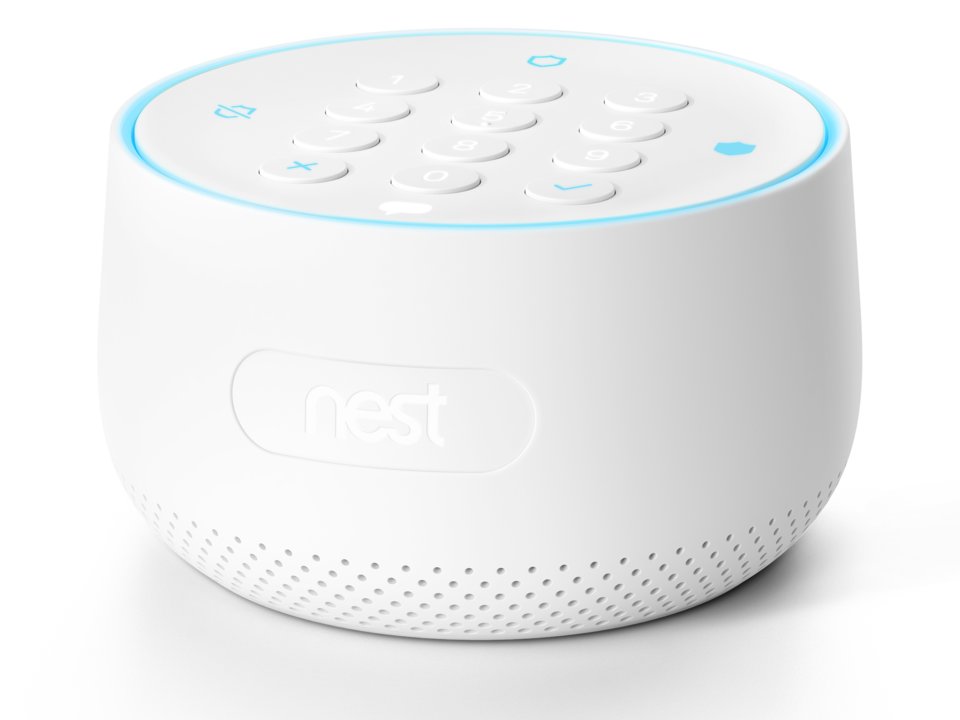
According to a new report, Google “unintentionally forgot” to mention the existence of a microphone on the Next Guard. The report mentioned that Nest users were unaware that the Nest Guard comes with a microphone as it was not mentioned anywhere including the website and the spec sheet.
Oh, Google’s justification was:
The spokesperson also mentioned that the on-device microphone was never on and is only activated when users specifically enable the option. Moreover, Google stated that they added the microphone as a way to allow for future developments and to add more security features to the device through software updates.
In early February, Google announced that its home security and alarm system Nest Secure would be getting an update — users could now enable its virtual assistant technology, Google Assistant. The problem: Nest users didn’t know a microphone even existed on their security device to begin with. The existence of a microphone on the Nest Guard (which is the alarm, keypad, and motion sensor component in the Nest Secure offering) was never disclosed in any of the product material for the device. On Tuesday, a Google spokesperson told Business Insider the company had made an “error.”
OK folks, pop quiz, what else has Google or someone else put a microphone in without telling you? Your “Smart TV” or gaming console? You mesh network gizmo?
Isn’t there enough microphones in your house already?
Cell phone
Smart watch
Laptop
Children’s toys
Plus any speaker not in use can also act as a microphone. Think stereo, clock radio, television, sound bar, etc.
Please note that Google only needed a software update to turn on the microphone and that means others with ill intent could access it too.
Somehow when Jesus spoke those words in Luke, I don’t think he had Google in mind however, I guess we don’t have to wait until judgement day any more for our private deeds to be made public, just get the wrong organization or nation state to pay attention to you and the future can be now. Jesus tells us that we will be condemned by what comes to light and I’m sure that would be true in this life as well.
Apple is such a target rich environment of bad news that it’s no wonder that they have fallen in value and deservedly so. Apple’s Store is full of spyware and security flaws, they have legal troubles that are concerning, they have quit innovating. Below I will give you a brief summary of each article and a link to read it for yourself but be ready to be shocked. I don’t own any stock in FAANG companies but if you do, now would be a good time to sell.
FAANG is Facebook, Amazon, Apple, Netflix, Google
Apple App Makers Spying on You
Many major companies, like Air Canada, Hollister and Expedia, are recording every tap and swipe you make on their iPhone apps. In most cases you won’t even realize it. And they don’t need to ask for permission.
Apps like Abercrombie & Fitch, Hotels.com and Singapore Airlines also use Glassbox, a customer experience analytics firm, one of a handful of companies that allows developers to embed “session replay” technology into their apps. These session replays let app developers record the screen and play them back to see how its users interacted with the app to figure out if something didn’t work or if there was an error. Every tap, button push and keyboard entry is recorded — effectively screenshotted — and sent back to the app developers. Or, as Glassbox said in a recent tweet: “Imagine if your website or mobile app could see exactly what your customers do in real time, and why they did it?”
Apps that are submitted to Apple’s App Store must have a privacy policy, but none of the apps we reviewed make it clear in their policies that they record a user’s screen. Glassbox doesn’t require any special permission from Apple or from the user, so there’s no way a user would know.
Glassbox is one of many session replay services on the market. Appsee actively markets its “user recording” technology that lets developers “see your app through your user’s eyes,” while UXCam says it lets developers “watch recordings of your users’ sessions, including all their gestures and triggered events.”
Apple has released an iPhone update to fix a software flaw that allowed people to eavesdrop on others while using FaceTime. The bug enabled interlopers to turn an iPhone into a live microphone while using Group FaceTime. Callers were able to activate another person’s microphone remotely even before the person has accepted or rejected the call. Apple turned off the group-chat feature last week, after a 14-year-old boy in Tucson, Arizona, discovered the flaw. The teenager, Grant Thompson, and his mother said they unsuccessfully tried to contact the company about the problem for more than a week.
FYI: Apple will never admit fault or flaws with any product or service until it has been made public and the publicity has embarrassed the crap out of them. This and the fact that their PC market share is so small has allowed them to falsely claim that they are more secure than Windows. Their iPhone apps are a mess despite their claims.
Turns out is not just Facebook and Google who are misusing Apple’s Enterprise Certificate Program to distribute apps which would not pass Apple’s App Store approval process. Techcrunch has discovered that hundreds of companies are distributing pornography and gambling apps to members of the public using the certificate system designed for only internal use.
The news, however, underlines that the supposedly safe and secure iPhone ecosystem has a rather seedy underbelly…
As previously reported on this blog, Apple iPhones have been banned for sale in China and Germany due to patent infringement. Here is an update on the story from a German Court.
Apple and Qualcomm have been at loggerheads for a while now, with the firm suing Apple over its alleged patent infringement. Qualcomm won a victory against Apple in Germany, acquiring an injunction which would stop Apple from selling iPhone models that used Intel chips in their retail stores, forcing Apple to pull their devices from sale both in-store and online.
Apple as of now has resumed sales of its iPhone 7 and 8 family of devices with Qualcomm chips in Germany.
The Securities and Exchange Commission has brought suit against Gene Daniel Levoff, who was Apple’s senior director of corporate law until September 2018. Levoff is accused of using his position to make illegal trades of Apple shares. Levoff was part of Apple’s Disclosure Committee—one of the people who could review the company’s quarterly financial reports ahead of their publication. The SEC maintains that he used nonpublic information obtained as part of the committee to inform trades he made of Apple shares. For example, in July 2015 he learned that Apple was going to miss analyst estimates for iPhone unit sales. Between July 17 and July 21, when Apple published its quarterly earnings report, he sold nearly his entire holding of Apple stock, totaling nearly $10 million. When the news became public, Apple’s share price dropped by more than 4 percent—selling early avoided losses of approximately $345,000.
Considering what they did to Martha Stewart for $50K, they better throw the book at this guy.
Apple Stops Innovating iPhone
Apple’s cash cow—the iPhone—for the last decade is running out of steam and new ideas. As reported here previously, they have no plans to release a true 5G phone in 2019, they are reportedly going to shift to USB-C connector in 2020 (more on this in a minute), they have announced no R & D for a foldable tablet or phone, and they are shifting to an Android style display. But still no micro USB memory slot.
As per the report, Apple is also planning to shift its display technology to OLED for the 2019 iPhone family of devices. OLED displays are more visually appealing than LCDs subjectively speaking and show deeper blacks and greater contrast. In other words, they ‘pop’ more and look prettier in stores. They also tend to feature on higher-end Android smartphones, something Apple may be reacting to as sales fall in China and India as consumers prefer their own homegrown, full-featured Android smartphones.
Apple has stopped reporting sales numbers for any devices on their quarterly stock reports due to declining sales but since they have fallen into the 90 Calendar trap, they are trying a new way to improve their cash flow. The new idea is to fleece their flock by offering subscription services. As such they are rolling out two new services, a subscription news service and a streaming service.
Apple, is expected to have a March 25 event at its Cupertino campus, where it could introduce the entertainment service, a new magazine subscription app and an update to its popular AirPods wireless earbuds. Apple, coming off declining iPhone sales, is looking to make up the difference.
…Apple will offer the service for free for the first three months, as an app, like iTunes, available on iPhones, iPads, computers and via the Apple TV set-top box and then begin charging. His prediction: $3 monthly if bundled with Apple’s current $9.99 Apple Music offering, or $6.99 as a stand-alone product. That’s a good deal cheaper than industry leader Netflix, which charges $11.99 for its most popular rate, but then Apple will have a tiny library in comparison. CBS, which also debuted with a smaller library for its All Access offering of originals (new Star Trek, and a sequel to the Good Wife) and library titles like Perry Mason and Cheers, charges $5.99 monthly, with ads, or $9.99 ad-free. Apple’s track record in entertainment isn’t stellar. It debuted two new series in 2017, the widely panned Planet of the Apps reality show in 2017 and an extended version of the CBS late night comedy bit Carpool Karaoke. It also debuted in 2017 with five episodes, but hasn’t been heard from since. Apple reported falling iPhone sales in its most recent earnings report, down 15 percent for the holiday quarter, but a booming business for its Services, which includes iCloud online storage, Apple Music and iTunes movie rentals. The company said Services revenue rose $10.9 billion, or 19 percent, over the previous year.
Are people really willing to pay $7 or more to watch shows they can only view on their phones? Color me skeptical. At lest with USB-C phones, you can hook them up to a computer monitor or television and view the content but a phone only person? You already have Netflix, Amazon, Hulu, CBS All Access plus Disney and Warner are starting their own streaming services; all of which you can watch on any device that you own. Apple is late to the party and they only plan to let you watch on their devices. Lastly, as mentioned above, content is going to be a problem. Heck Netflix is suffering due to the content pulled already for services that aren’t even live yet.
Apple is planning to launch an all-you-can-read news subscription service, but is running into resistance from The New York Times Co. and Washington Post, both of which want better terms, the Wall Street Journal reports. Apple’s negotiators are reportedly floating an all-in-one news subscription plan that would cost consumers $10 per month, with Apple keeping half, and the remaining money getting split among all the other publishers on the platform, based on how much time people spend reading stories from each outlet.
Apple keeps half and gives crumbs to everyone else. Also please note that they are the ones that decide how much to pay all the news contributors based on how many hits each story gets.
Conclusion
I keep saying Tim Cook is just a caretaker and I think I’ve been vindicated in spades on that claim. Apple is no longer a leader in next generation technology, instead, they are just interested in making the current generation more comfortable in their old age.
Folks this action should disturb you greatly. We are told backing up our personal information to “the cloud” is smart, secure and safe; except for Google which admits that it scans your personal data so they can target you with advertisements but then assures us that nobody human really reads your stuff.
Anyway, this news story surfaces today that Apple is giving away private iCloud passwords just to be nice to people that Tim Cook agrees with politically.
Three years after Apple refused to give the federal government access to the devices used by the San Bernadino terrorists who killed and injured dozens in a mass shooting event, the company has given the office of the Special Counsel complete access to Trump advisor Roger Stone’s iCloud account, reports Apple Insider. According to the Washington Post, Apple objected to giving the federal government backdoor access to the shooters iPhones, claiming it would “set a dangerous precedent.”
Fast forward to present, and we see that Apple no longer seems to have the same privacy concerns it once did in 2015. Without any fight, they simply turned over Roger Stone’s iCloud passwords and God knows what else, because Orange Man Bad. The fact that Apple views a political persecution less of a hill to die on than protecting the rights of terrorists who killed and maimed dozens of Americans is quite telling.
You may not like Roger Stone and you may not agree with him. However, he has been charged with non-violent process crimes…
Folks, our Republic is in trouble. On one hand Apple is willing to turn your data over to the government because your political party is different than their CEO but simultaneously they defend the privacy rights of terrorists and murderers that killed American citizens in cold blood. What’s going on?
If you thought Facebook and Google were the only tech companies that didn’t care about your privacy you might want to re-evaluate that idea.
Apple is living off the legacy of Steve Jobs, Steve is dead and whatever goodwill he may have had died with him. The company that he created is emerging from his shadow and it a quite a different and inferior thing.
Final Thought
If Mr. Stone is using iCloud then presumably he is using Apple’s iPhone. Did Apple give Mueller all their tracking data and telephone logs on him as well? FYI — phone manufacturers and app developers can use the GPS of your smartphone to track all your movements and use algorithms to develop information about your daily routine. This data is frequently monetized.
FAANG is Facebook, Apple, Amazon, Netflix, Google
Tim Cook and the boys in Silicon Valley know way more about American citizens than J. Edgar Hoover ever did and on an unimaginable scale. Liberals are OK with Cook et al. but not Hoover? Makes you wonder…
Elon Musk is great at separating Liberals from their money. He flits around like a butterfly from one pipedream to another. Electric cars, solar power, batteries, space flights to Mars, and mag-lift travel at the speed of sound. Whatever crazy thing he can get other people to invest in. He will make prototypes or other devices to get others to invest, but please note, its other people’s money at risk not his. Musk takes a cut for himself off the top and then piles more investors into the bottom of the pyramid.
He bought Solar City, and it was financially unsustainable so what does he do? Why he folds the debt into his Tesla car scheme. Tesla isn’t panning out financially so what then? Oh, I know, why doesn’t he act like a crazy guy and get kicked off the board. Then when the bills come due and it collapses Musk won’t be on the board. Then he can blame the Musk-less board for not having the vision, passion, and dedication that he had to make it succeed. If only he had been there…
Look back to last summer. Remember Musk having a Twitter tantrum about the rescuer of the kids in the cave. He called the guy a pedophile or something like that. Then he smokes marijuana on that pod cast and then pulls the stunt of taking the Tesla private. Net result, Musk gets kicked off the board of his own company.
Is he nuts of crazy like a fox? He has access to information investors and other don’t plus he can read the handwriting on the wall. Get out before the stuff hits the fan that way he can save face and blame others. This allows him to go fleece his next group of Liberals with his reputation still intact.
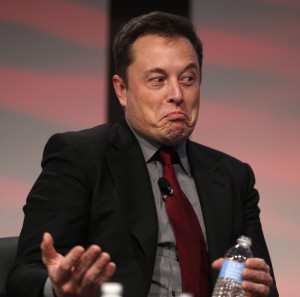
Elon Musk with the look that says, “It’s not personal, it’s business”
Here’s more proof the Ponzi scheme is in trouble.
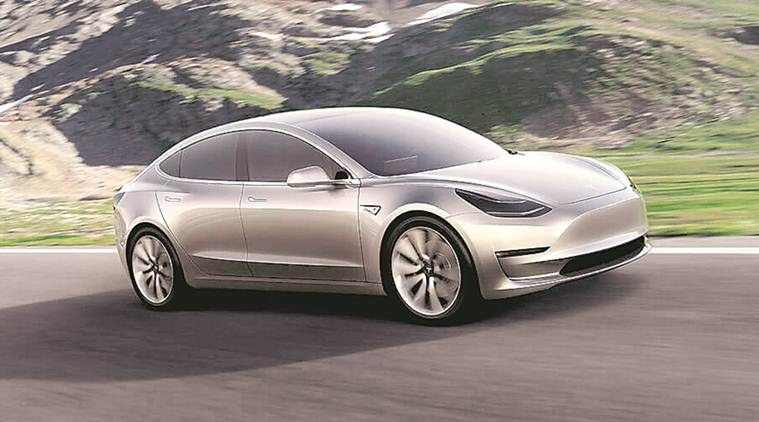
Tesla has lowered the price of its Model 3 by $1,100 amid reports that U.S. sales fell precipitously in January despite a $2,000 reduction that went into effect at the beginning of the month. InsideEVs estimates that Tesla sold 6,500 Model 3s in the U.S. in January, which would represent a more than70 percent drop from the prior month.
Cutting prices and a 70 percent drop in sales in one month is bad enough but the other shoe is about to drop.
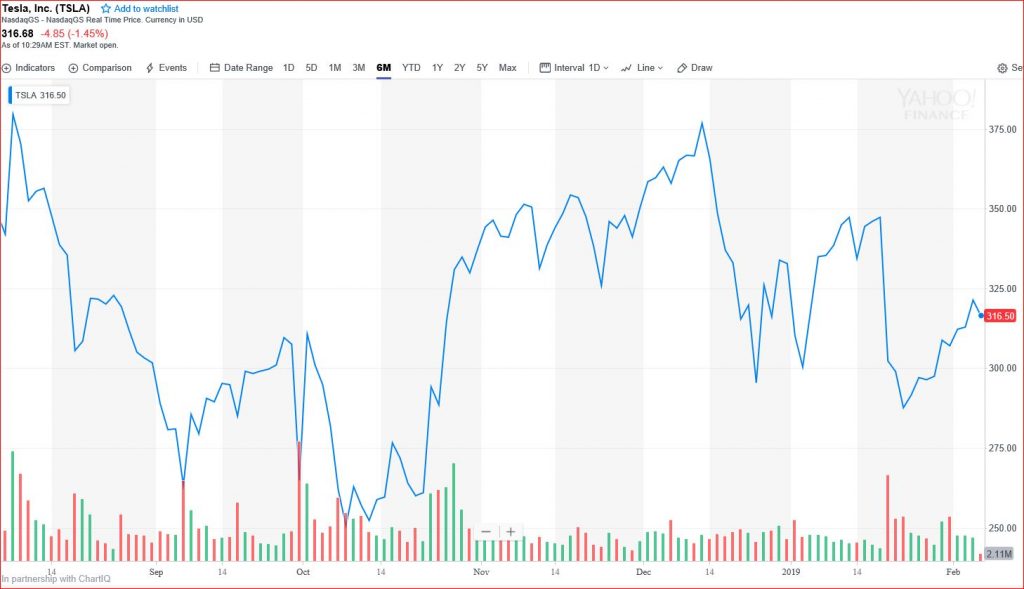
Tesla has a billion dollar debt coming due, and it could wipe out nearly a third of the company’s cash if the stock price doesn’t improve. About $920 million in convertible senior notes expires on March 1 at a conversion price of $359.87 per share. But Tesla’s stock hasn’t traded above $359 for weeks. If the shares are about $359.87, then Tesla’s debt converts into Tesla shares. If not, Tesla will have to pay the debt in cash. Tesla reported cash and cash equivalents of $3 billion at the end of its September quarter. The company continues to reveal pressure to maintain profitability, and announced Friday it would cut 7 percent of its full-time workforce.
Please note that the 3 billion cash and equivalents was in September. They are burning thru cash at a crazy rate and to pony-up one billion in cash in three weeks is a tall order.
Below is a chart of Tesla stock for the last six months. Do you really think that the stock price will be above $359.87 by March first when January sales are off 70 percent? No way Jose. Stock opened trading today at $316.50
Tesla Stock for last six months
Tesla is in deep trouble but never worry because Musk got in the lifeboat months ago to distance himself from the dumpster fire that’s coming.
Ok so Apple lying in and of itself this is nothing new. Let’s look at their track record over the last few years.
Apple throttles performance and battery life of their old phones to get people to buy new iPhones.
Their top selling antivirus app for several years was in reality a spyware program.
They trick gullible people into paying double or triple for inferior technology and their slick marketing affirms that their stuff is better when it is often obsolete or old tech.
They steal tech from other people without attribution or proper payment of patented technology.
Apple fails to offer features on their phones that have been available from other manufacturers for over a decade—can you say “SD Card”?
Given the above, why is it any wonder that they plan to lie to their customers yet again? We all know that Apple is the only cell phone manufacturer on the planet, and yes I do mean anywhere on planet Earth, that has publically stated they will NOT offer a 5G phone in 2019. But now this little gem shows up on tech websites today:
AT&T is planning to sell its updated 4G network as “5G Evolution” in the US. Even though your phone will be connected to an updated 4G network, you will see a “5G E” indicator on your phone. In the recently released iOS 12.2 beta release, Apple has added support for this fake 5G network.
If you are running iOS 12.2 beta on the latest iPhones (XR, XS, and XS Max), you will be seeing this new 5G E network indicator in over 400 markets. When AT&T launches real 5G network later this year, it will be indicated as “5G+”.
So Apple is just going to call 4G connectivity 5G just so they and AT&T can market a lie. Apple lies in hopes that their shareholders won’t continue to cry.
Folks by the international standards that have been set, what we call 4G in the United States is really not 4G speed. The designation 4GLTE is “4G light”. This is their way of saying it’s not really 4G but faster than what we sold as 3G. Looks like a similar scheme is being rolled-out by Tim Cook and Ma Bell. AT&T and Apple are going to call something closer to a real 4G standard network as “5G Evolution”. Clearly this 5GE designation only exists in the minds of the marketing department.
Bottom line, if it’s an Apple product, it can’t run on a true 5G network, period. Any claim to the contrary is a lie. One I’m sure that will be used to separate people from their money at a $1,000 or more per phone. Apple’s iPhone, it’s not 5G, and still can’t use an SD Card.
Skynet is tracking you if you are a Netflix subscriber. OK, it’s not really steel robots with automatic weapons kicking in your door for violating their terms of service but it’s close.
Skynet is coming
The way it works, is that streaming service companies hire the UK firm Synamedia that uses AI, behavioral analytics and machine learning to monitor and analyse password sharing activity across user accounts, identify the rule breakers and detect the fine line between finding account sharers and harassing a customer. “For example, the solution can determine whether users are viewing at their main home and a holiday home, or whether they have shared credentials with friends or grown-up children who live away from home.
If you let your kids watch your Netflix account, they may be looking for you.
Research quoted by Synamedia reported that younger generations are used to accessing streaming services for free and rarely become paying customers. The company revealed that 26% of millennials share passwords for video streaming services, while economic predictions indicate that in 2021, $9.9 billion of pay-tv revenues and $1.2 billion of over-the-top media services (OTT) revenues will be lost to credentials sharing. “Casual credentials sharing is becoming too expensive to ignore. Our new solution gives operators the ability to take action. Many casual users will be happy to pay an additional fee for a premium, shared service with a greater number of concurrent users. It’s a great way to keep honest people honest while benefiting from an incremental revenue stream,” said Jean Marc Racine, CPO and GM EMEA of Synamedia.
Netflix and other streaming services know what you are watching and where you watch (via your network I.P. address) so why the third party tracking? Perhaps the A.I. will automatically notify you and send you a bill to upgrade your account to make what you watch legit? It’s not like they don’t use other algorithms and A.I. on your account, how do you think they get the 98 percent match on the suggested show?
Why is this sharing of data OK when Facebook is in deep doo-doo for sharing data with third party folks like Cambridge Analytica? The sharing by both companies was done in exchange for revenue and increased viewers, thus enhancing their stock value. Facebook’s only crime was that they did something that might have benefitted Republicans and for that they must be punished.
Which brings me to the other tech article of the day that is worth a read. It is published by the Hollywood Reporter. The article concerns a unique lawsuit against Facebook for the Cambridge Analytica story.
Cambridge Analytica parlayed its modest access to the lives of ordinary Facebook users and their family and friends into more and more information — enough to begin psychologically profiling American voters and then bombarding them with phony and real news. And Facebook’s role? “This kind of mass data collection was not only allowed but encouraged by Facebook, which sought to keep developers building on its platform and provide companies with all the tools they need to influence and manipulate user behavior,” states the March 23 lawsuit filed by Edelson. “That’s because Facebook is not a social media company; it is the largest data-mining operation in existence.”
What makes the Edelson lawsuit different is a name barely anyone knows: Kimberly Foxx, a state’s attorney, the top prosecutor in Cook County, Illinois. Edelson is ostensibly representing the people of Illinois through Foxx on a claim that Facebook engaged in unfair and deceptive conduct. Or, stated another way, a government official has outsourced law enforcement to a class-action attorney. Edelson, having now been given the role of a Special Assistant State’s Attorney thanks to possessing the “required legal expertise,” as a court order confirming his appointment put it, aims to punish Facebook for violating The Illinois Consumer Fraud and Deceptive Business Practices Act. It carries massive repercussions, including $50,000 in civil penalties per violation, injunctive relief and — if egregious circumstances call for it — a lost business license to operate in the state. That’s right. Theoretically, Facebook could pay billions and be prohibited from offering its service in Illinois if it loses this lawsuit.
Edelson’s claim that “Facebook is not a social media company; it is the largest data-mining operation in existence” does make me wonder how he would describe Google or all the apps and devices reporting to your personal data to China or our National Security Agency—after all they are the only part of our government that listens.
Privacy in our society is an illusion; one I may discuss on another occasion.
If you needed proof that the apple doesn’t fall far from the tree, in the first recorded case of one silicon based life form murdering another, a Tesla vehicle on autopilot ran down an autonomous robot, Promobot, on the streets of Las Vegas. As a pedestrian, the robot clearly had the right of way along the busy Las Vegas Strip but the Tesla ran him down without even slowing, let alone attempting to stop.
According to Promobot, a number of robots were making their way to the booth around 7 p.m. when one of them stepped out of line and into the parking lot roadway. As it did, it was struck by a Tesla Model S operating in autonomous mode. The crash tipped the robot onto its side, causing ‘serious damage,’ Promobot says. Now, with parts of its body, head, arm mechanisms, and movement platform destroyed, it cannot be put on display. The firm says the damage is likely irreparable.
The Tesla involved in the collision was operating autonomously, though a passenger was inside at the time. And, it continued driving another 50 meters after the accident before finally stopping.
There is no word on whether the Tesla passenger will be filing a civil suit for the trauma of helplessly having to witness the robot being run over while trapped inside the rogue vehicle. Please note that the Tesla only decided to stop after realizing that it had struck a pedestrian.
I saw this article and thought it worthy of giving you the highlights.
WASHINGTON, Dec 27 (Reuters) – President Donald Trump is considering an executive order in the new year to declare a national emergency that would bar U.S. companies from using telecommunications equipment made by China’s Huawei and ZTE, three sources familiar with the situation told Reuters. It would be the latest step by the Trump administration to cut Huawei Technologies Cos Ltd and ZTE Corp, two of China’s biggest network equipment companies, out of the U.S. market. The United States alleges that the two companies work at the behest of the Chinese government and that their equipment could be used to spy on Americans. The executive order, which has been under consideration for more than eight months, could be issued as early as January and would direct the Commerce Department to block U.S. companies from buying equipment from foreign telecommunications makers that pose significant national security risks, sources from the telecoms industry and the administration said.
In March, FCC Chairman Ajit Pai said “hidden ‘back doors’ to our networks in routers, switches — and virtually any other type of telecommunications equipment – can provide an avenue for hostile governments to inject viruses, launch denial-of-service attacks, steal data, and more.”
The executive order would invoke the International Emergency Economic Powers Act, a law that gives the president the authority to regulate commerce in response to a national emergency that threatens the United States. The issue has new urgency as U.S. wireless carriers look for partners as they prepare to adopt next generation 5G wireless networks. The order follows the passage of a defense policy bill in August that barred the U.S. government itself from using Huawei and ZTE equipment.
Rural operators in the United States are among the biggest customers of Huawei and ZTE, and fear the executive order would also require them to rip out existing Chinese-made equipment without compensation. Industry officials are divided on whether the administration could legally compel operators to do that.
I keep going back to the 1980’s and Japan’s mantra that “Business is war”. China has upped that idea to the Nth degree and average Americans could care less. China is not just an economic competitor but the biggest external threat to our freedom.